What Cof draws
compalecof is an AI tutor that explains by drawing. Ask a question and Cof, a small coffee cup, draws the answer step by step on a notebook page. Here are some of the topics Cof explains this way.
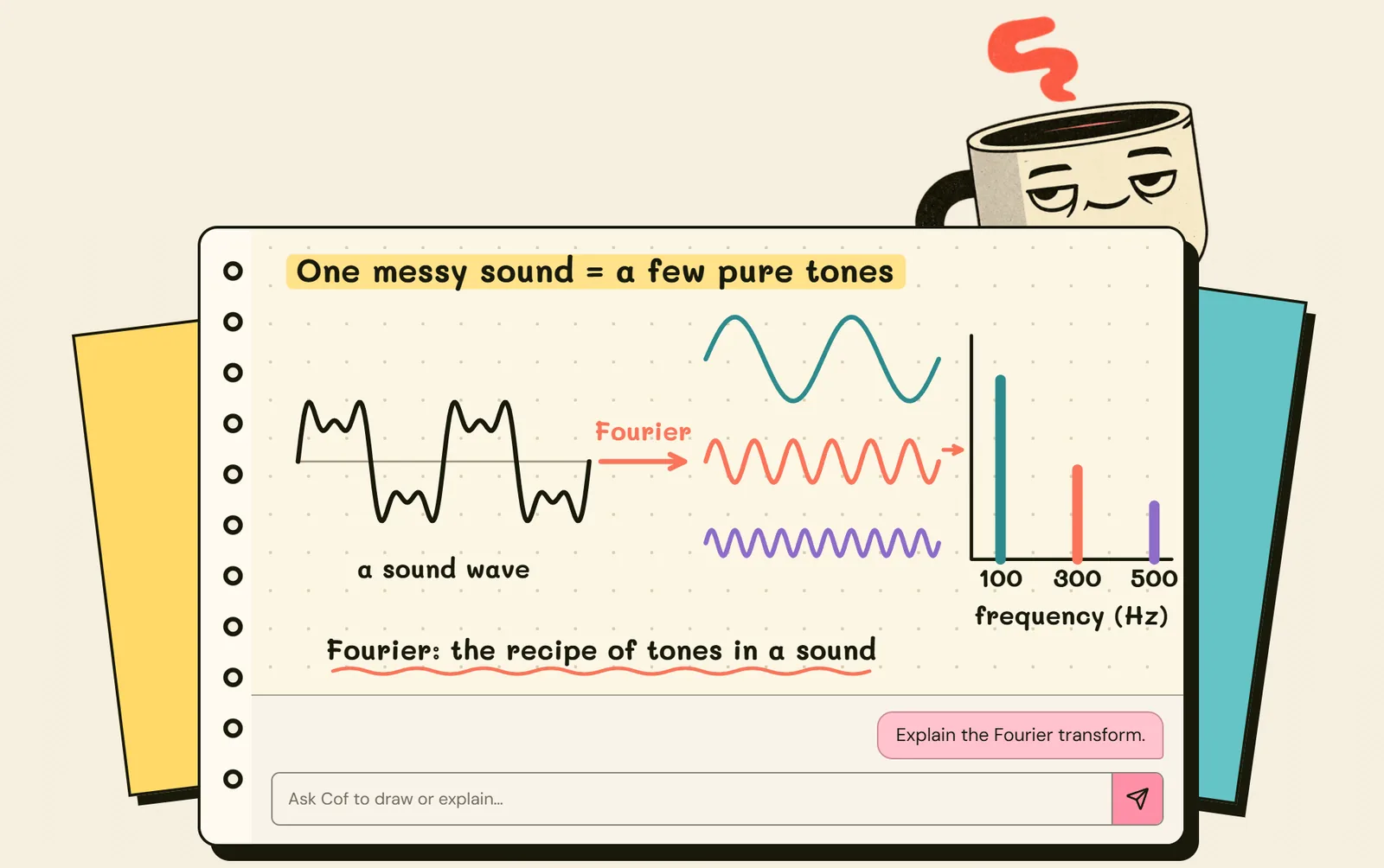
The Fourier transform asks which pure frequencies, and how strong, add up to a signal. Its answer is the spectrum: here three bars at 100, 300 and 500 Hz. More on this subject: Physics
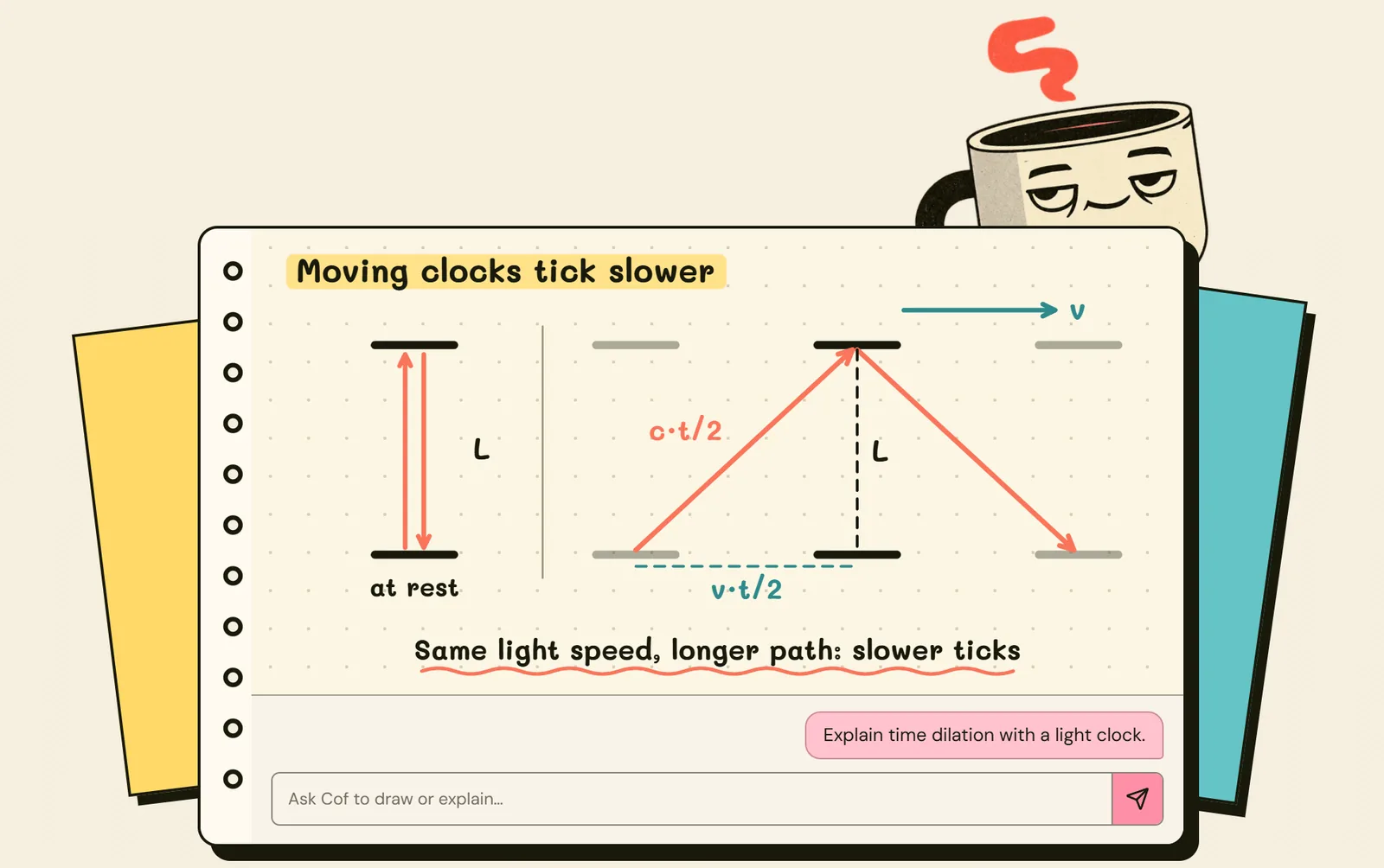
Light always moves at the same speed c. Seen from the platform, the light in a moving clock must travel a longer diagonal path, so each tick takes longer. More on this subject: Physics
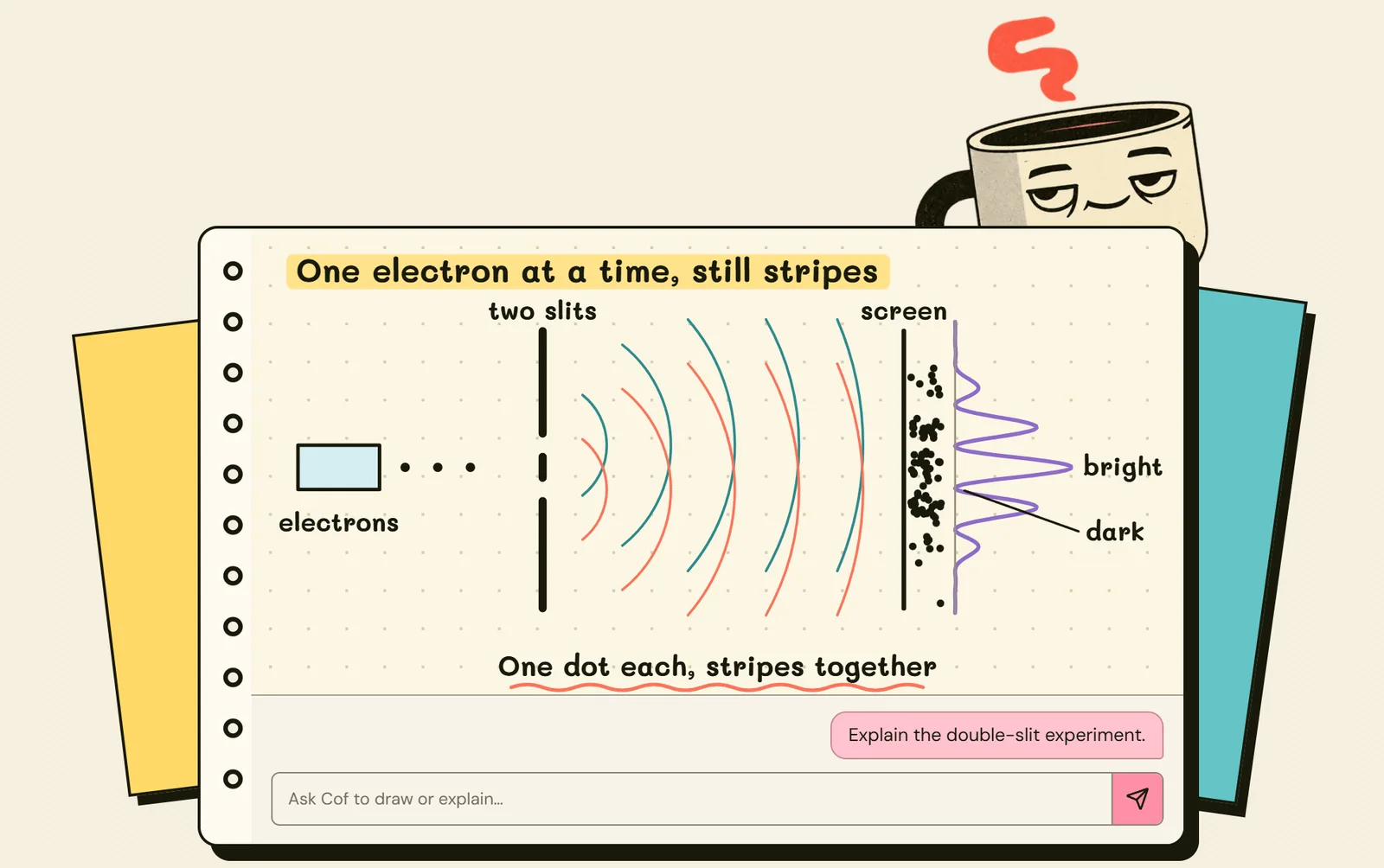
Each electron lands as a single dot, but over time the dots pile up into bright and dark stripes, as if each one passed through both slits like a wave. More on this subject: Physics
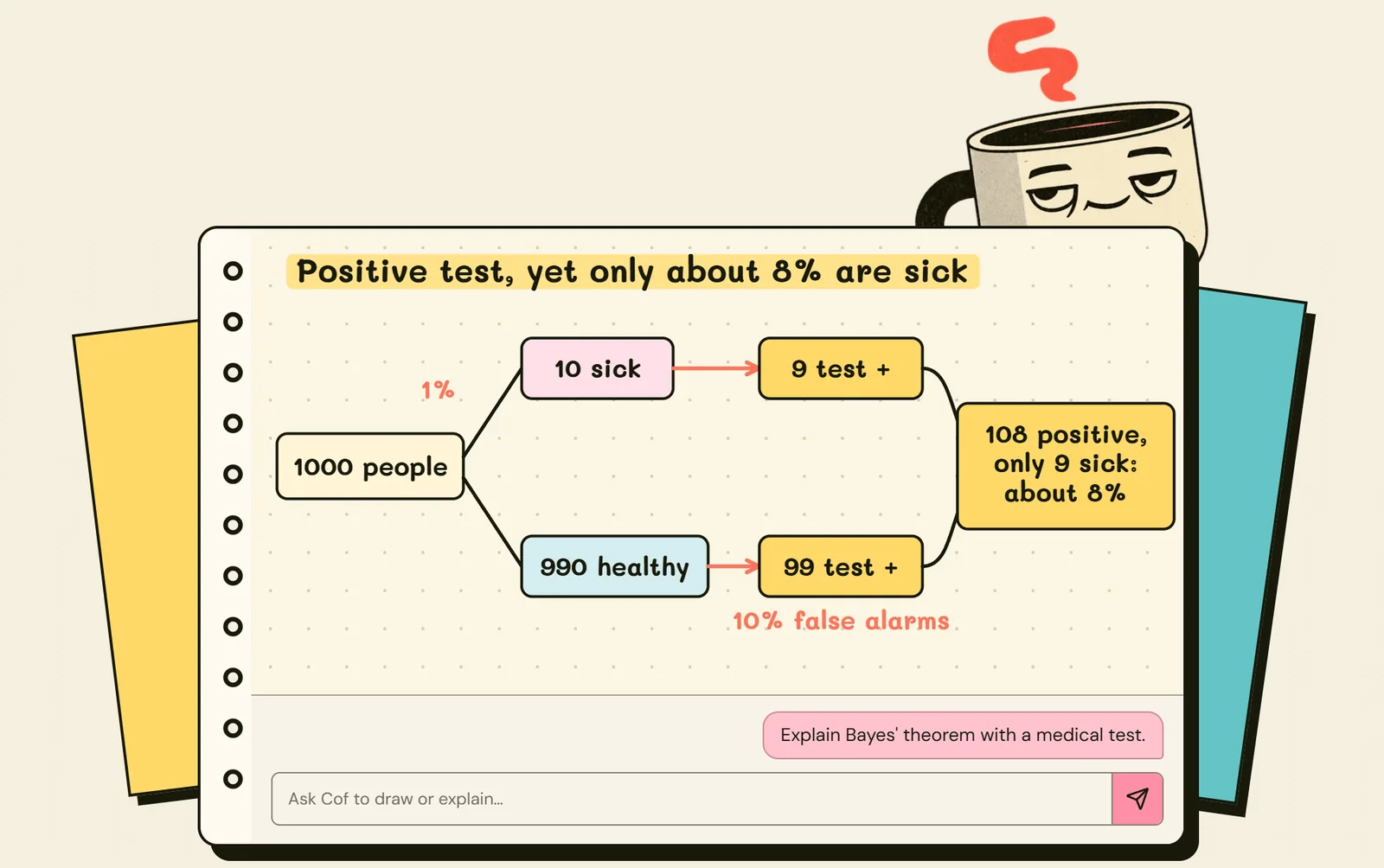
Out of 1000 people, 10 are sick and 9 of them test positive. But 10% of the 990 healthy people also test positive: 99 false alarms. So 9 of 108 positives are sick, about 8%. More on this subject: Math
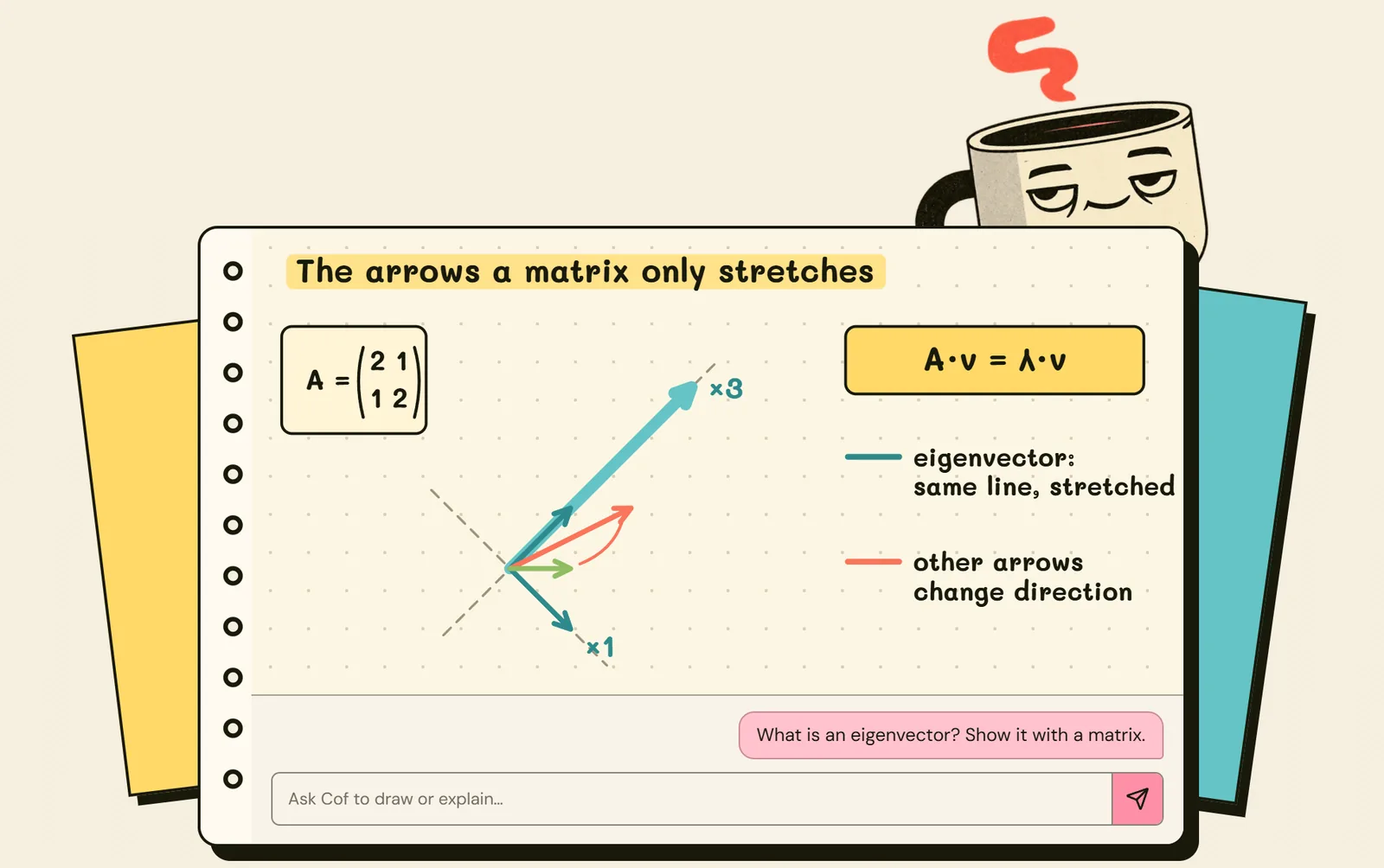
Most arrows get turned by a matrix: (1,0) becomes (2,1). An eigenvector keeps its direction and only gets longer or shorter; the eigenvalue is that stretch factor. More on this subject: Math
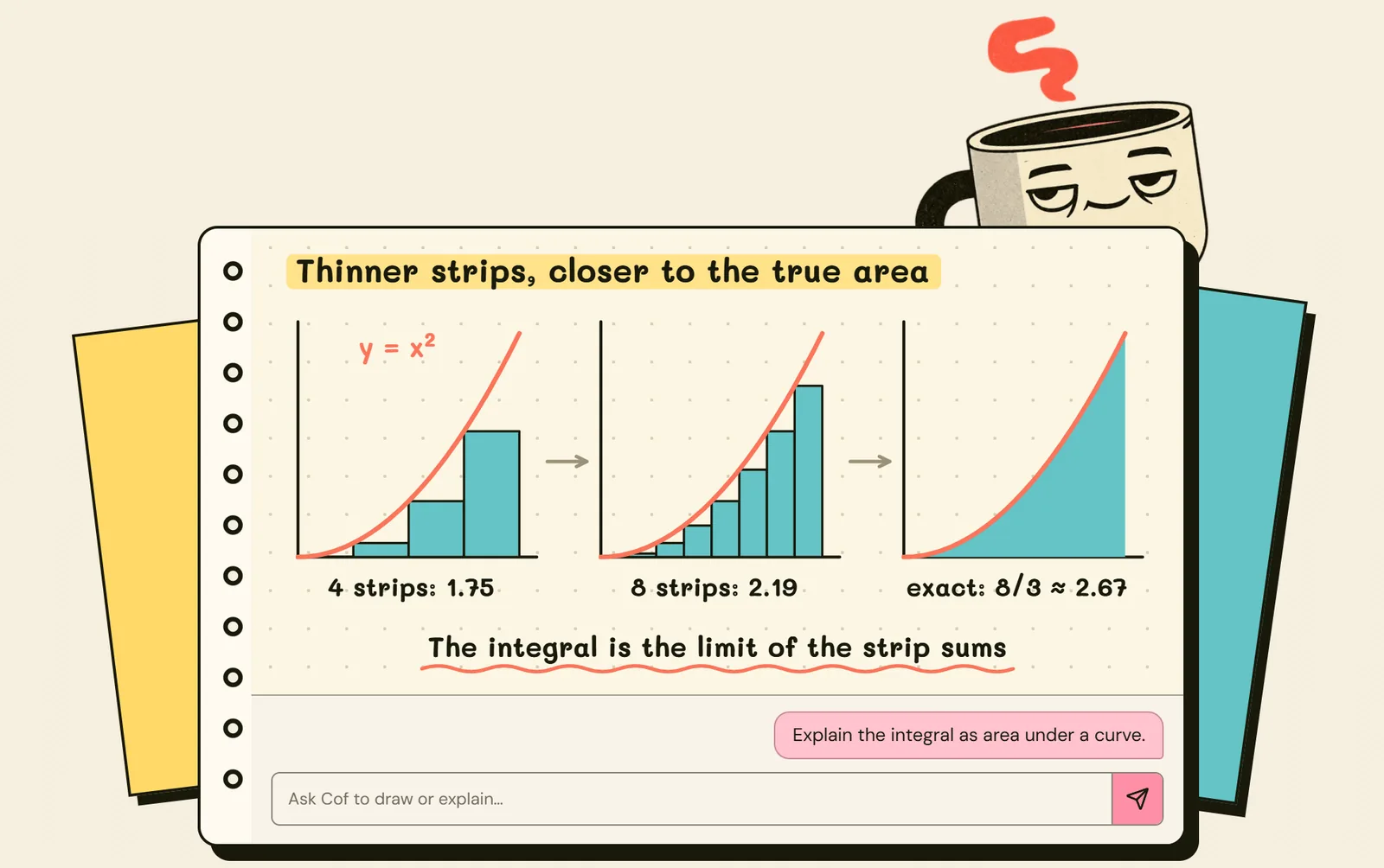
Cut the area under the curve into rectangles and add them up: 4 strips give 1.75, 8 strips give 2.19. With infinitely thin strips the sum becomes the integral, 8/3 ≈ 2.67. More on this subject: Math
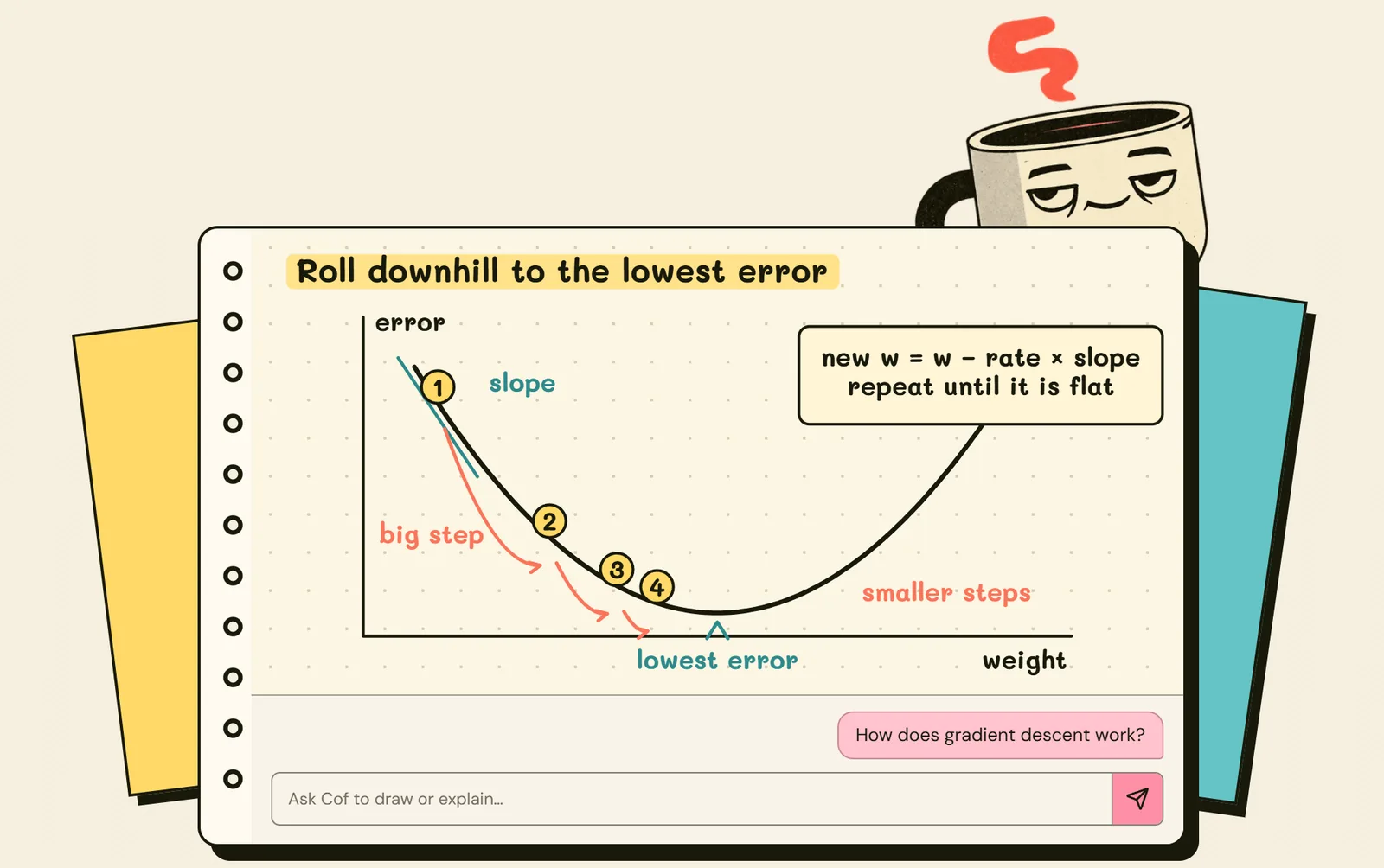
At each step, measure the slope and move the opposite way, a little: w goes −3, −1.8, −1.08, −0.65. As the slope flattens, the steps shrink. This is how neural networks learn. More on this subject: Math
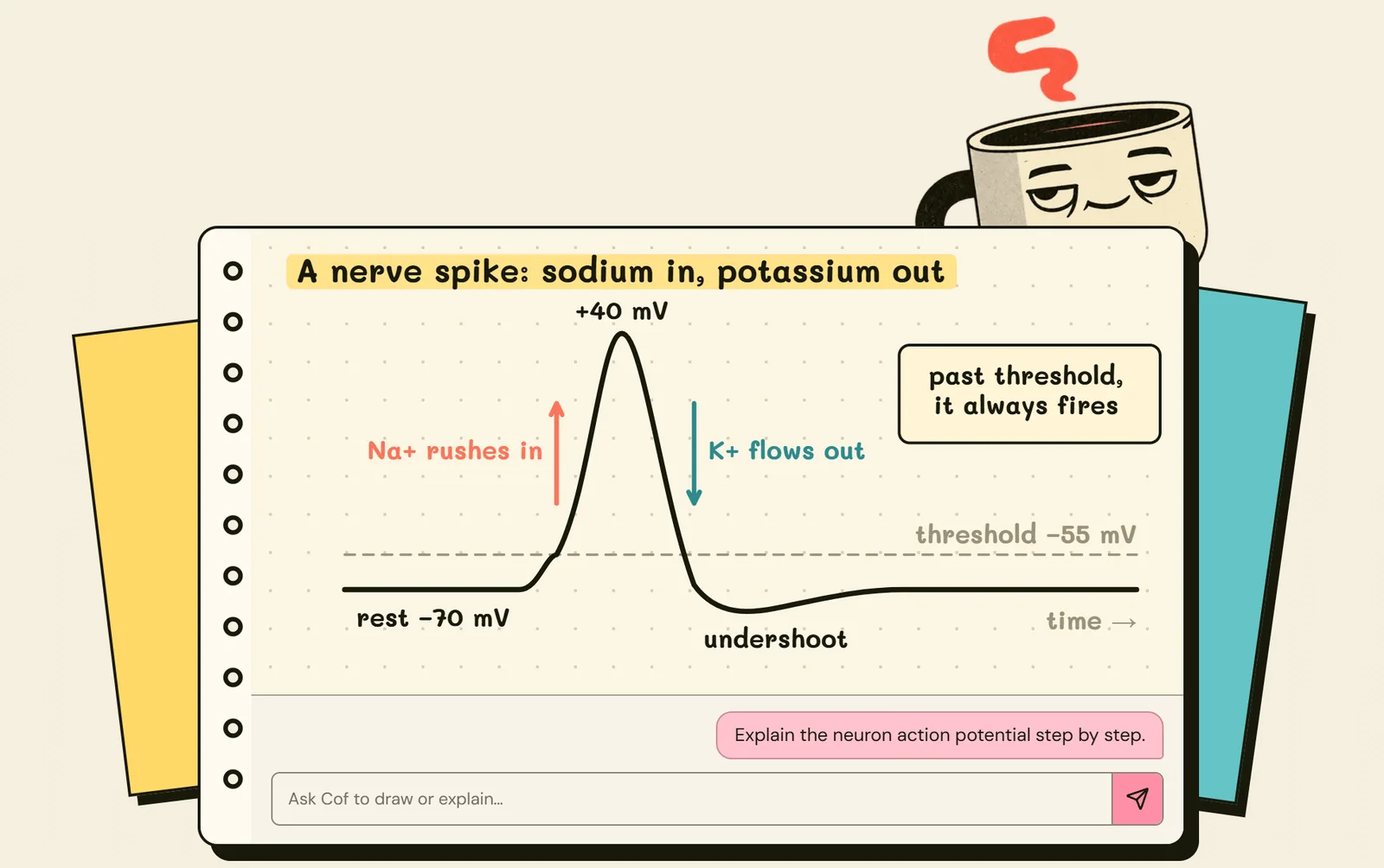
Once the membrane reaches the −55 mV threshold, sodium channels open and the inside turns positive. Then potassium leaves, the voltage dips below rest and recovers. More on this subject: Biology
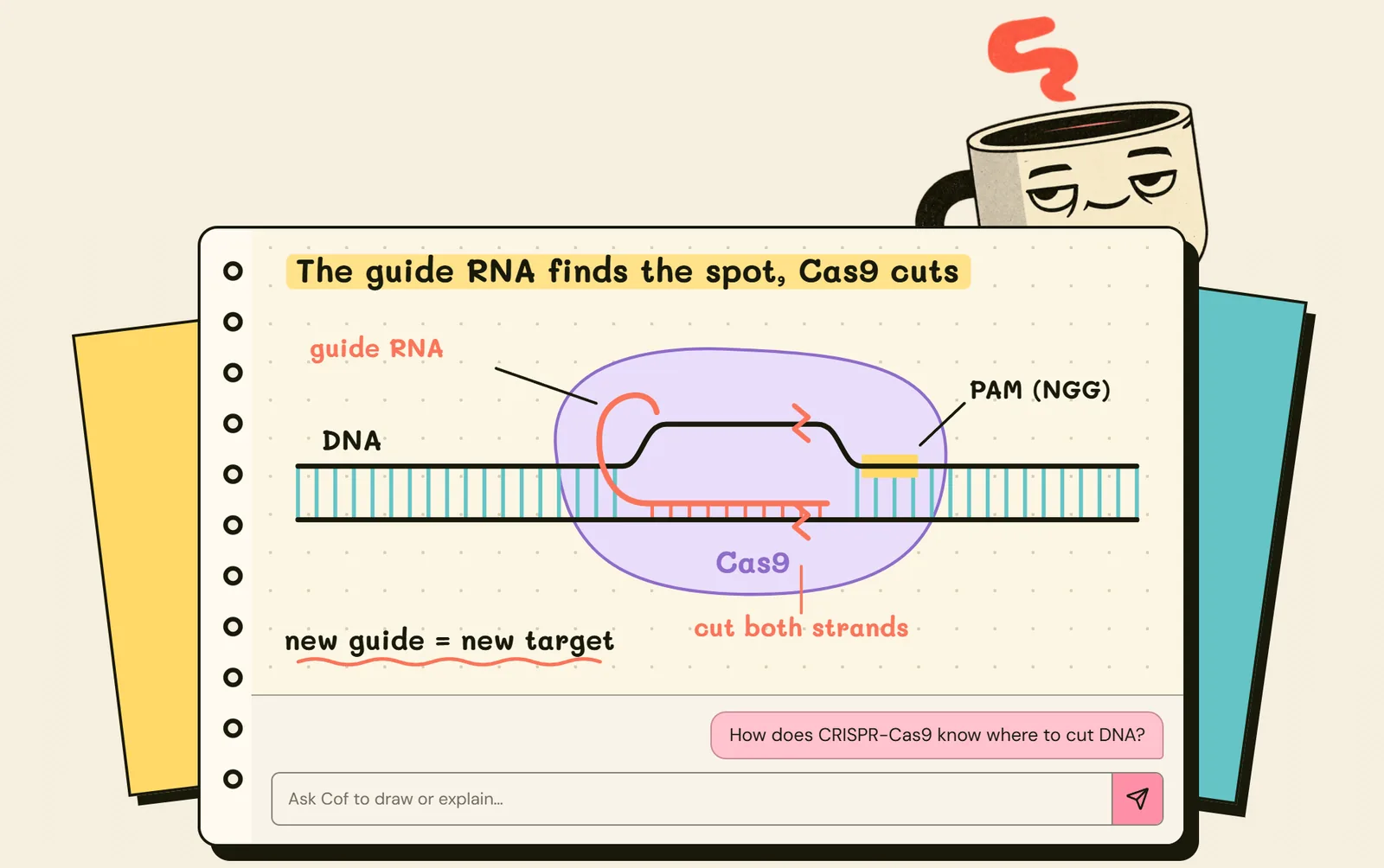
Cas9 is a pair of molecular scissors. The guide RNA is the address: it pairs with matching DNA next to a short PAM sequence, and Cas9 cuts just before it. The cell repairs the cut, and that is where an edit can go in. More on this subject: Biology
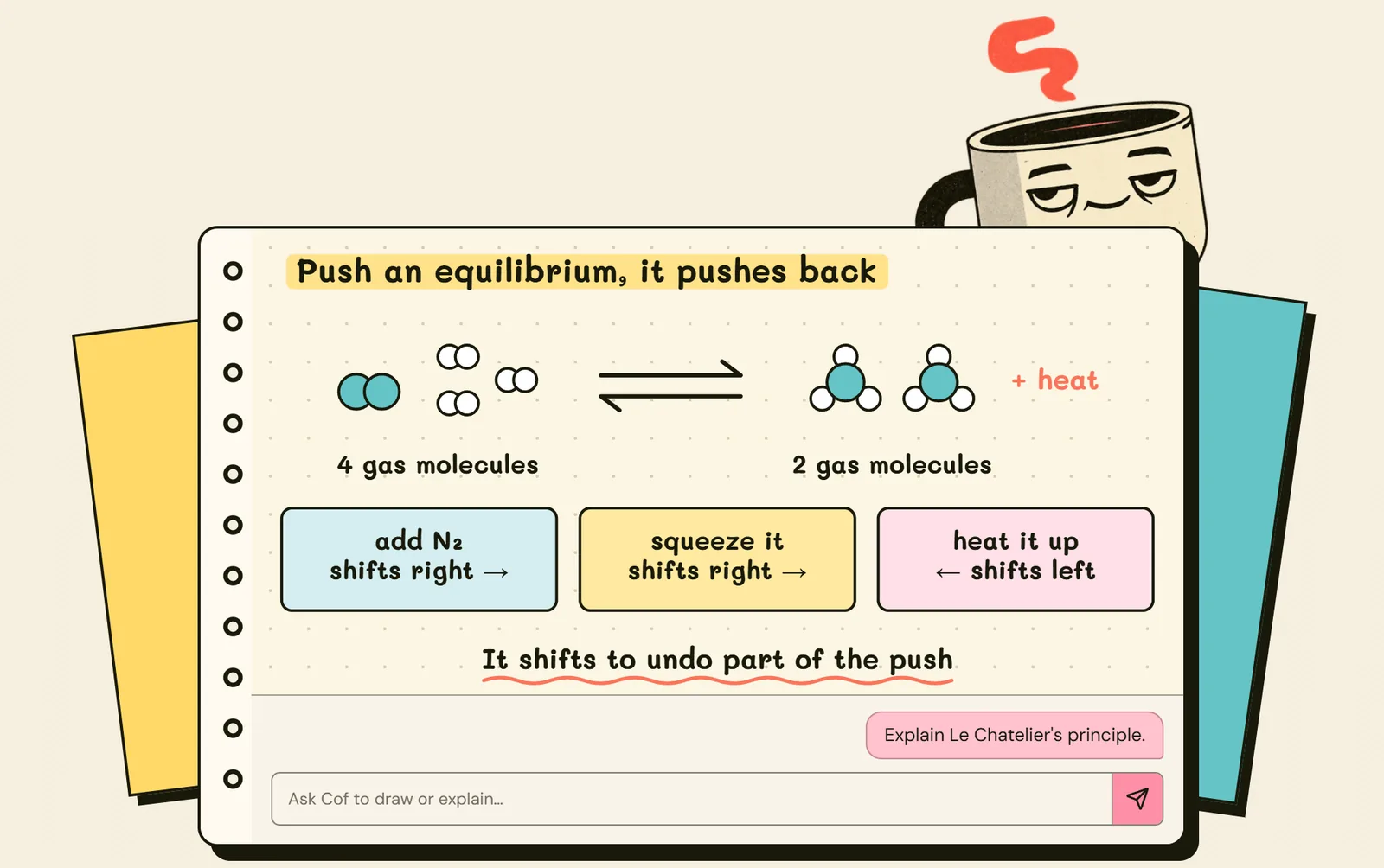
A system at equilibrium shifts to undo a change. Extra N₂ gets used up; higher pressure favors the side with fewer gas molecules (4 → 2); extra heat favors the reaction that absorbs it.
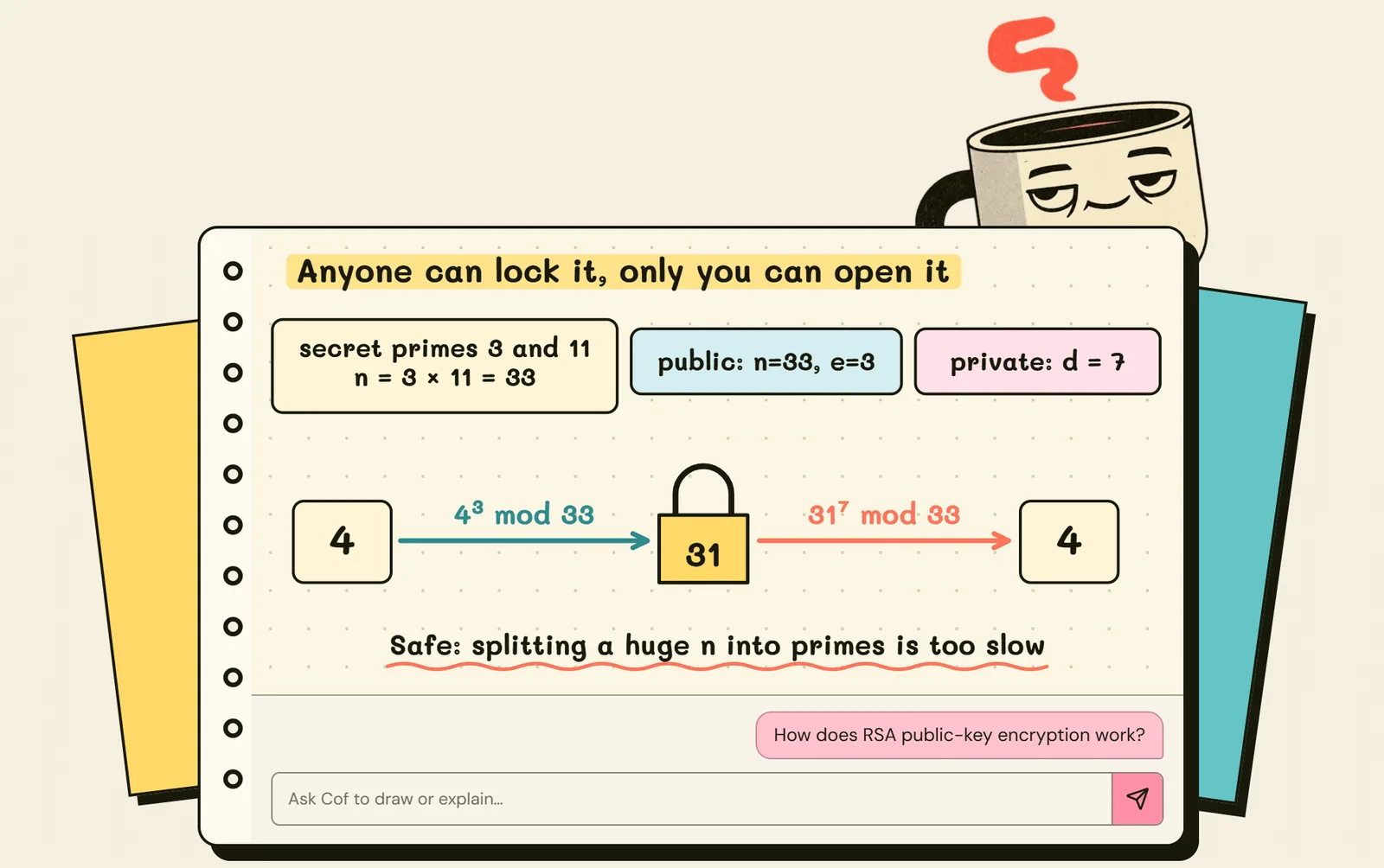
Pick two primes, 3 and 11, so n = 33. Locking is 4³ mod 33 = 31; unlocking is 31⁷ mod 33 = 4. Finding 7 needs the primes, and splitting a huge n back into primes is too hard. More on this subject: Coding
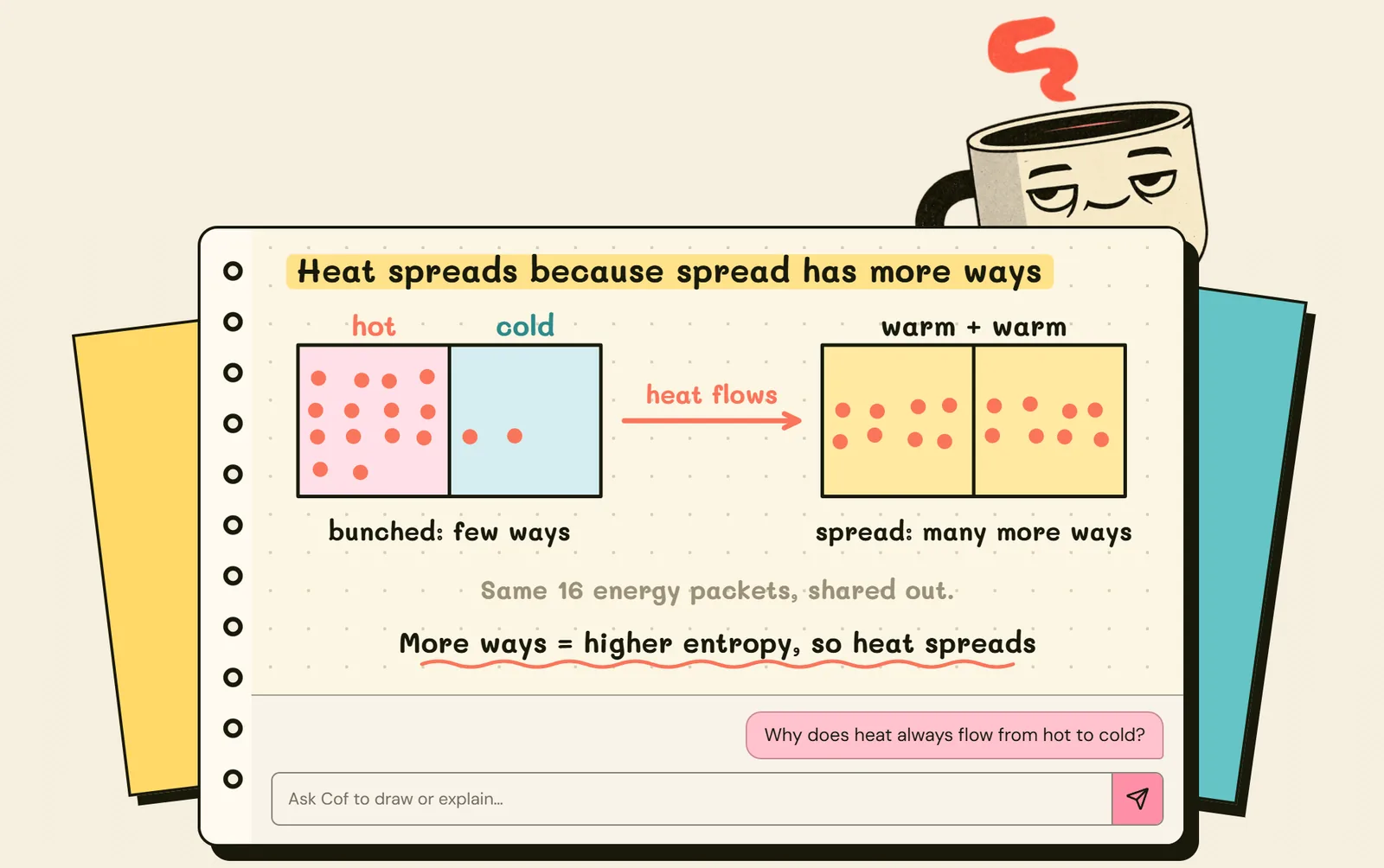
Energy comes in little packets that hop around at random. There are far more arrangements with the packets shared evenly, so the system almost always ends up there. Entropy counts those arrangements. More on this subject: Physics
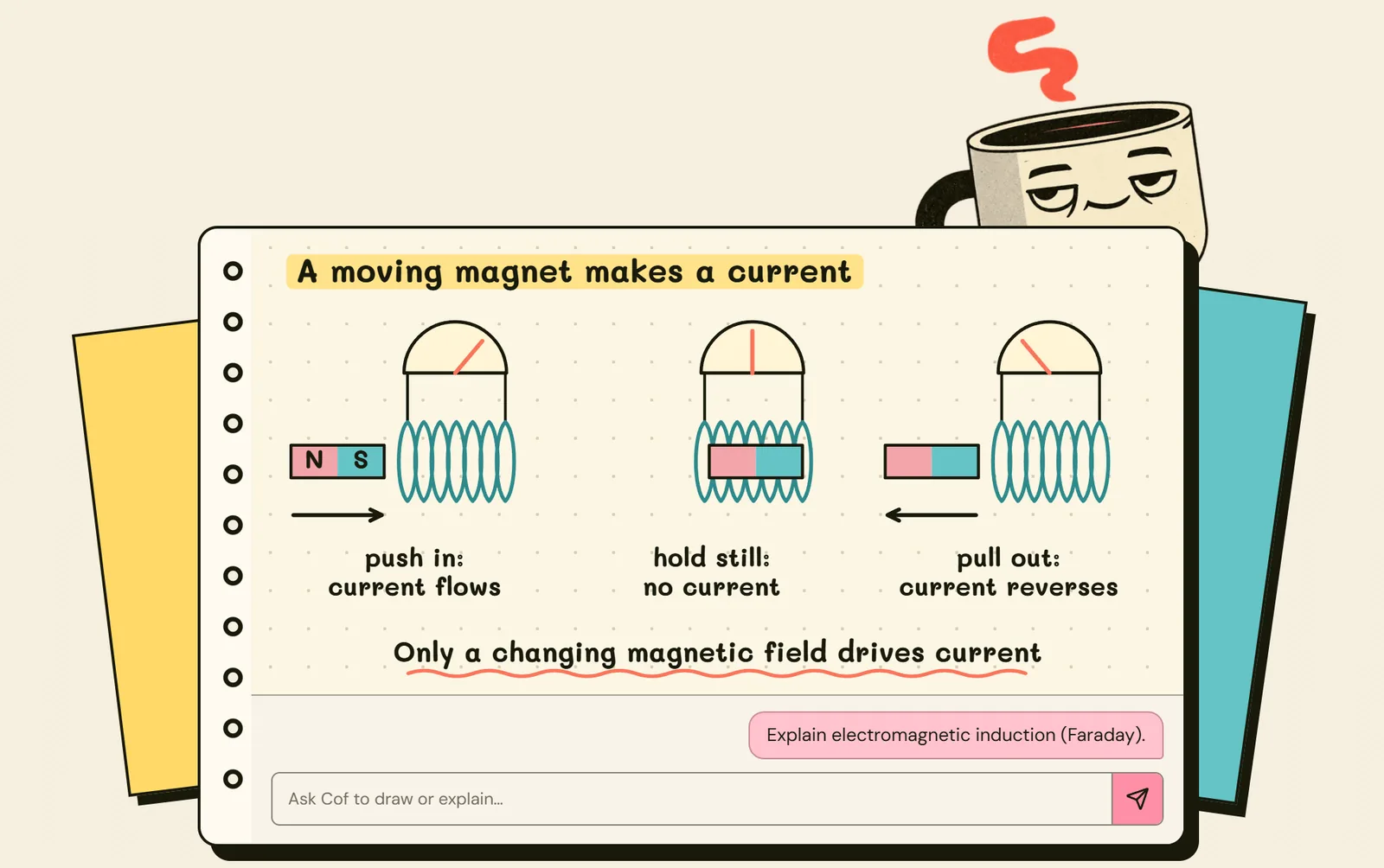
Only a changing magnetic field drives a current. The faster the magnet moves, the bigger the current; that is how generators and bike dynamos make electricity. More on this subject: Physics
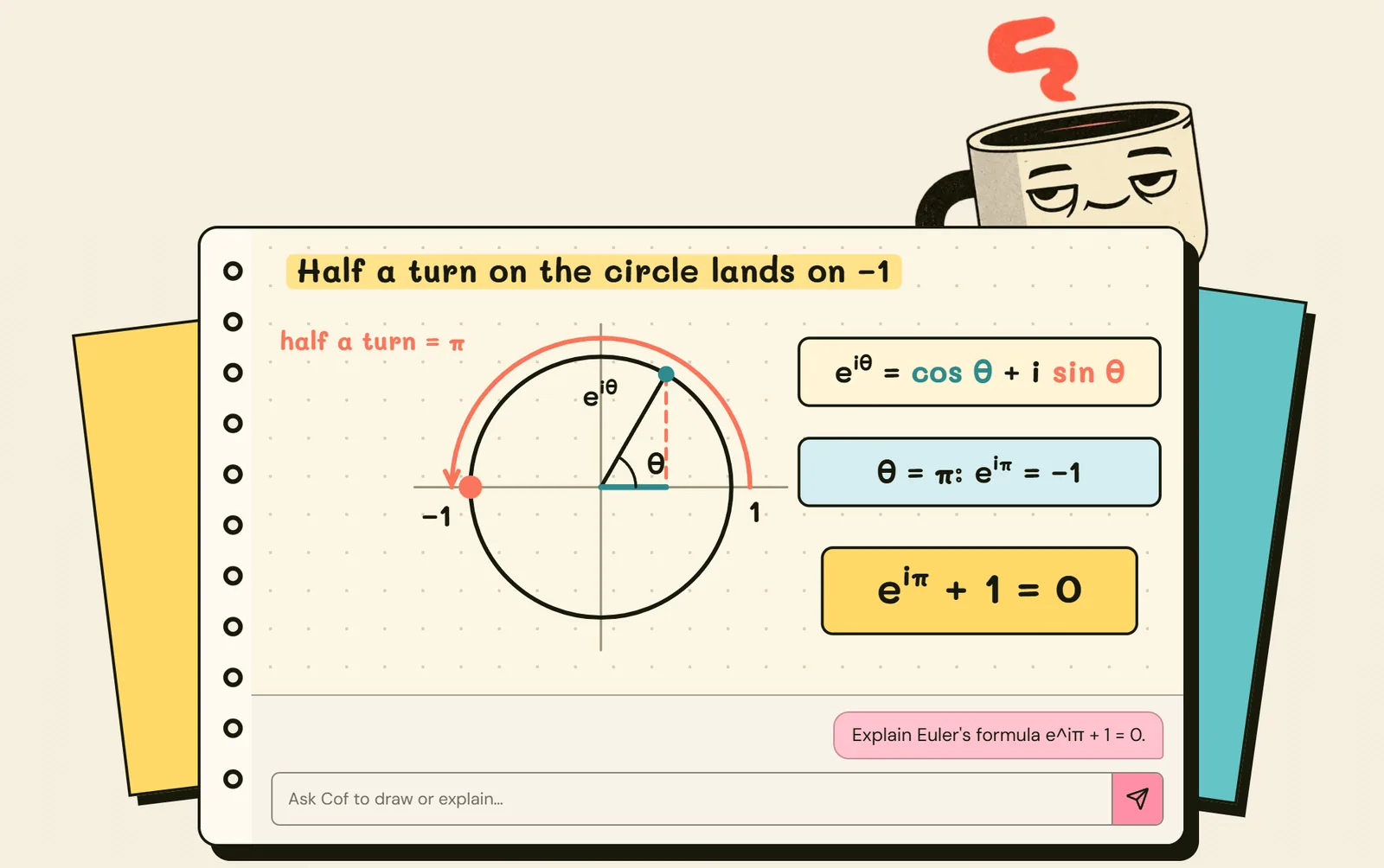
Multiplying by e^(iθ) rotates a point by the angle θ on the unit circle. Rotating 1 by half a turn, π radians, gives −1: that is e^(iπ) + 1 = 0. More on this subject: Math
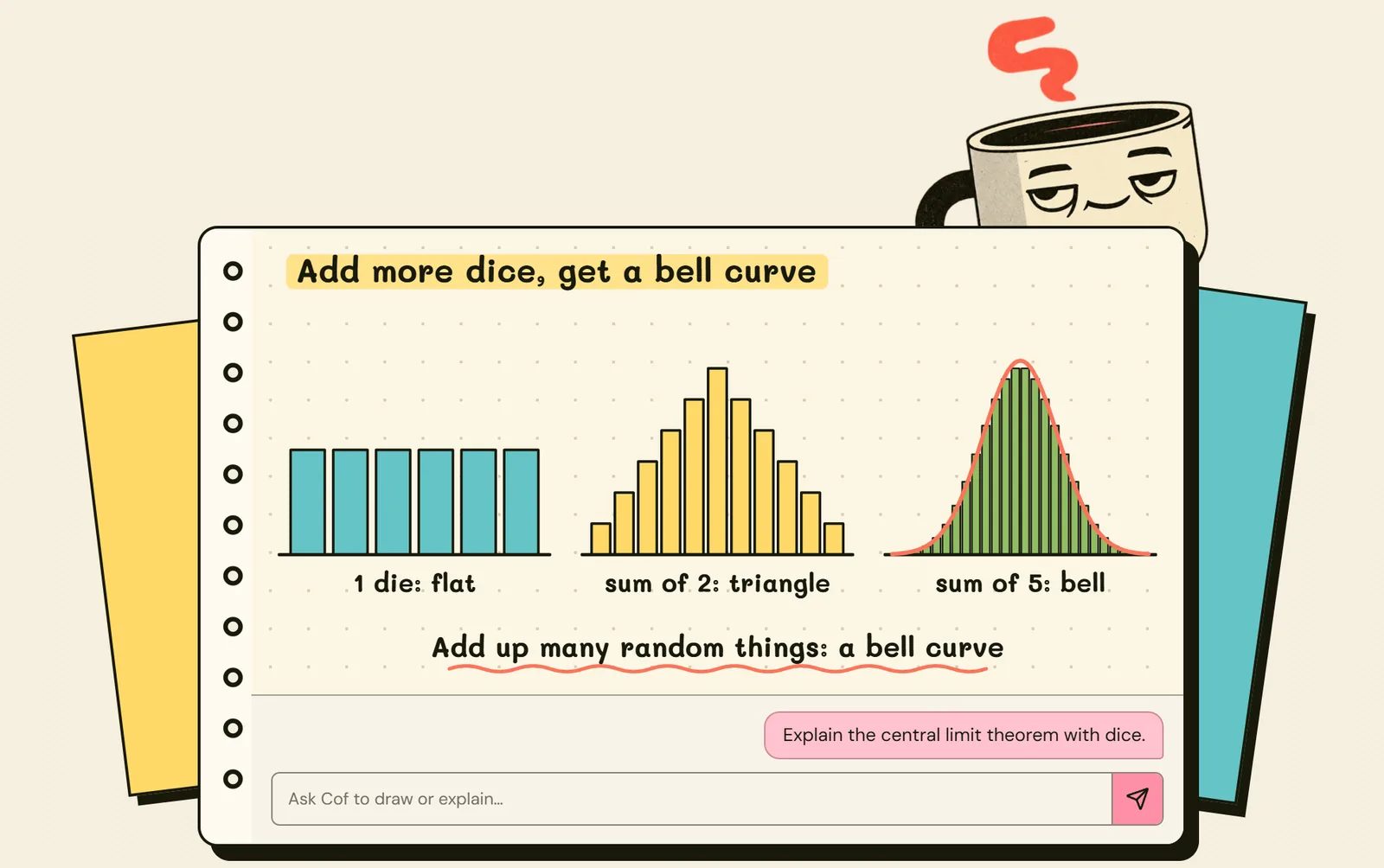
Add up many independent random things and their total follows a bell curve, whatever each one looks like on its own. That is why the normal distribution shows up everywhere. More on this subject: Math
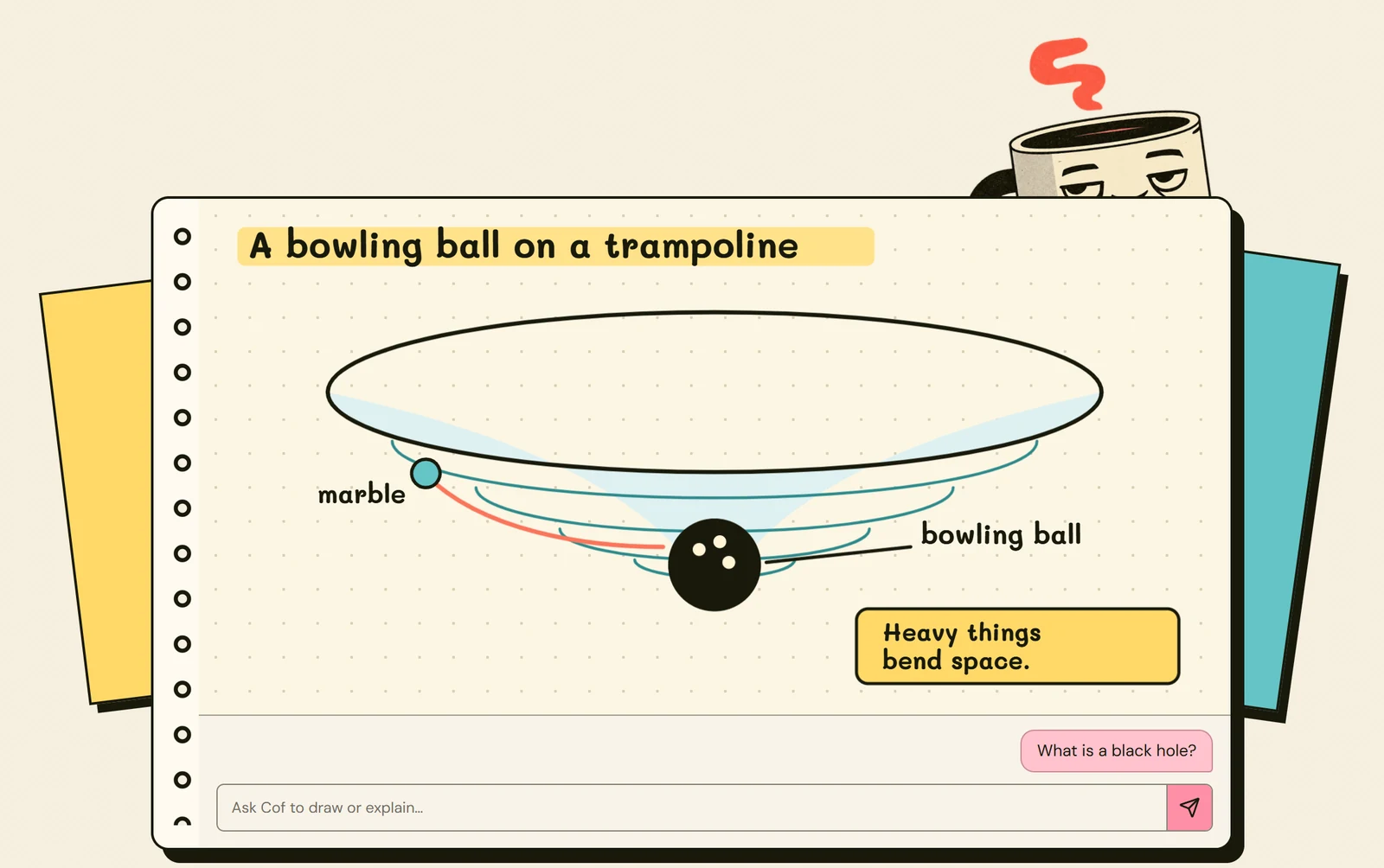
Mass bends space the way a heavy ball dents a trampoline, and things nearby roll toward it. A black hole is so dense that the dent gets too steep for even light to climb out. More on this subject: Physics
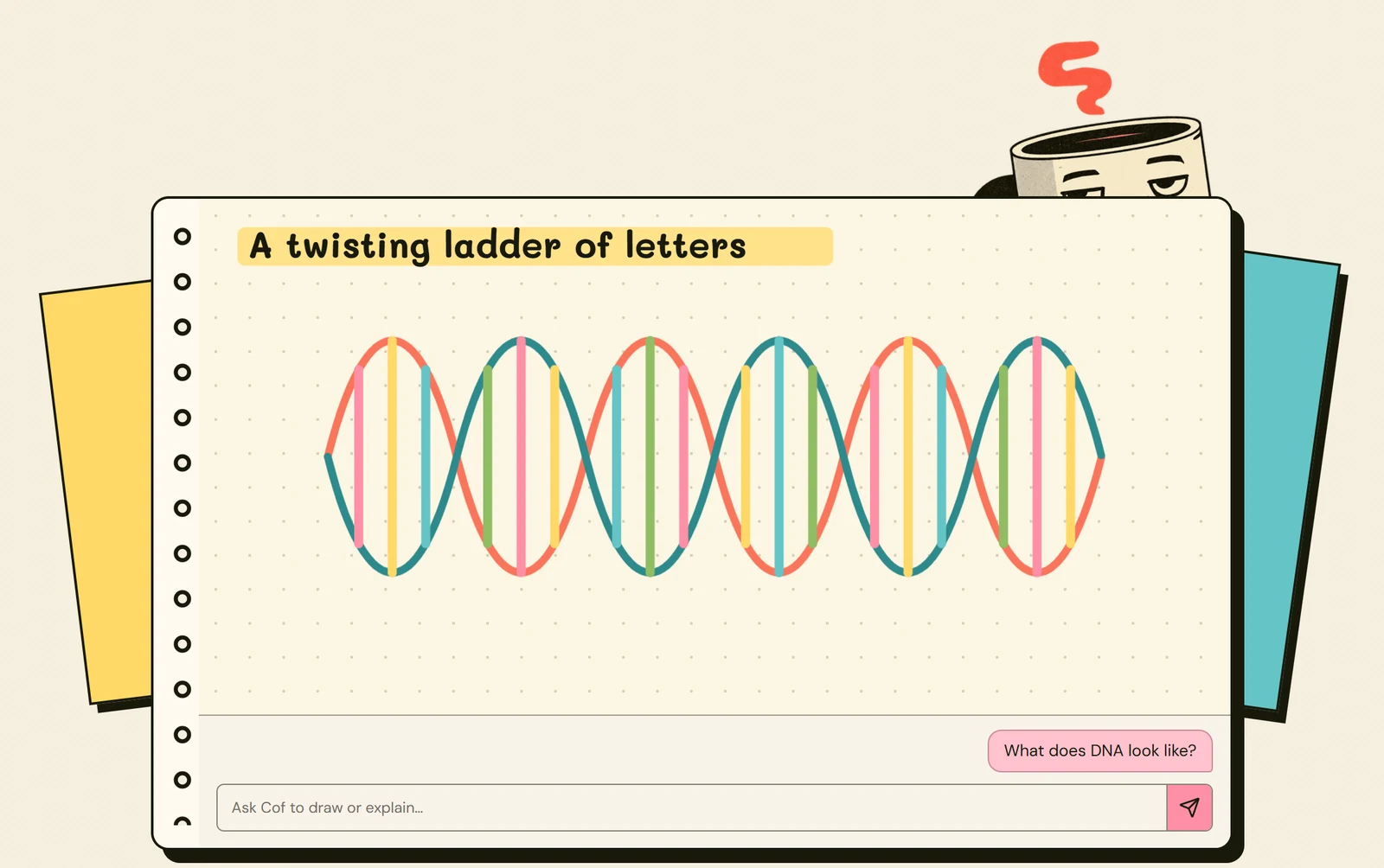
DNA is two strands twisted into a double helix. The rungs are pairs of bases: A always pairs with T, and G with C. More on this subject: Biology
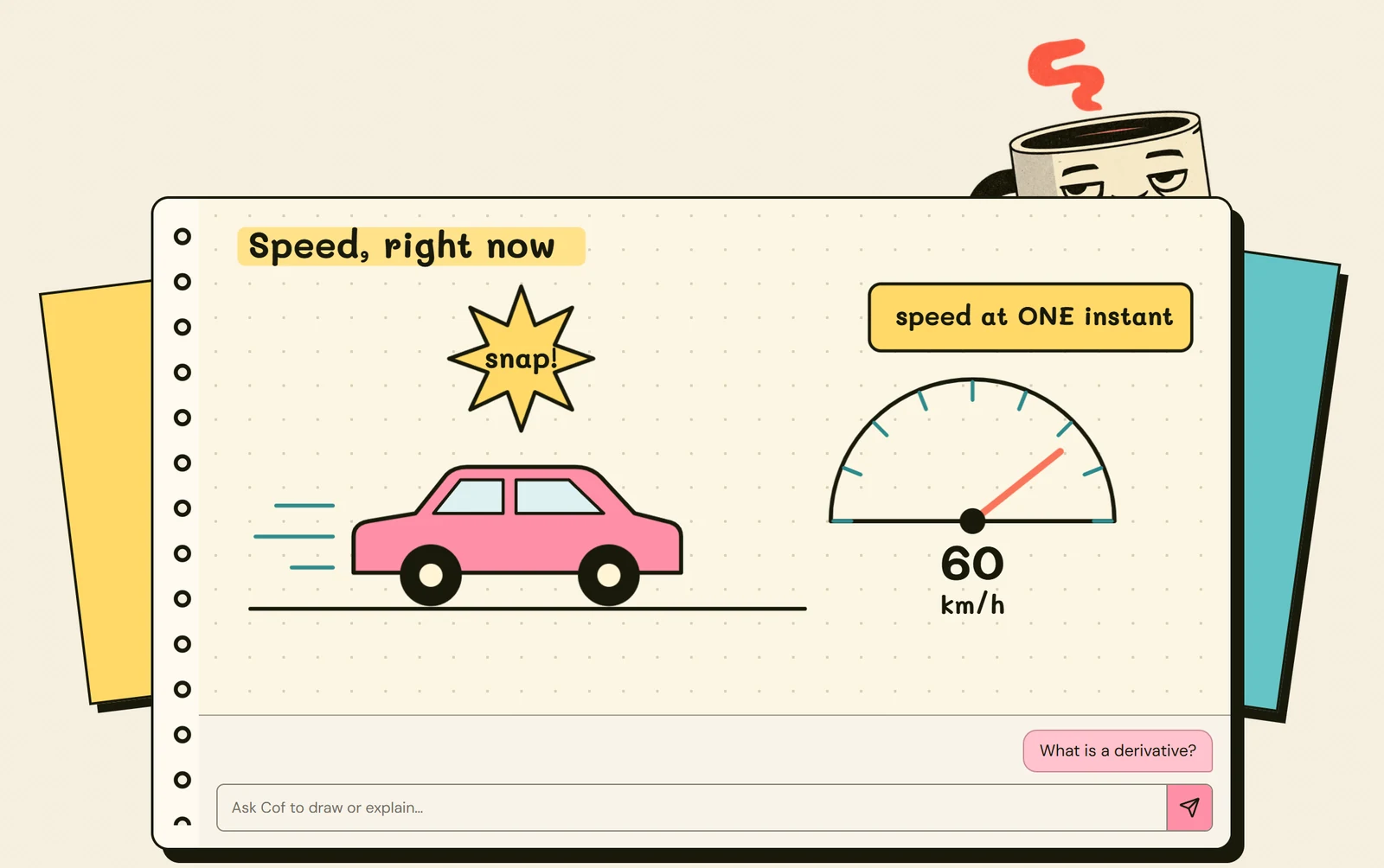
A derivative tells you how fast something changes at one exact moment, like the number on a speedometer, not the average speed of the whole trip. More on this subject: Math
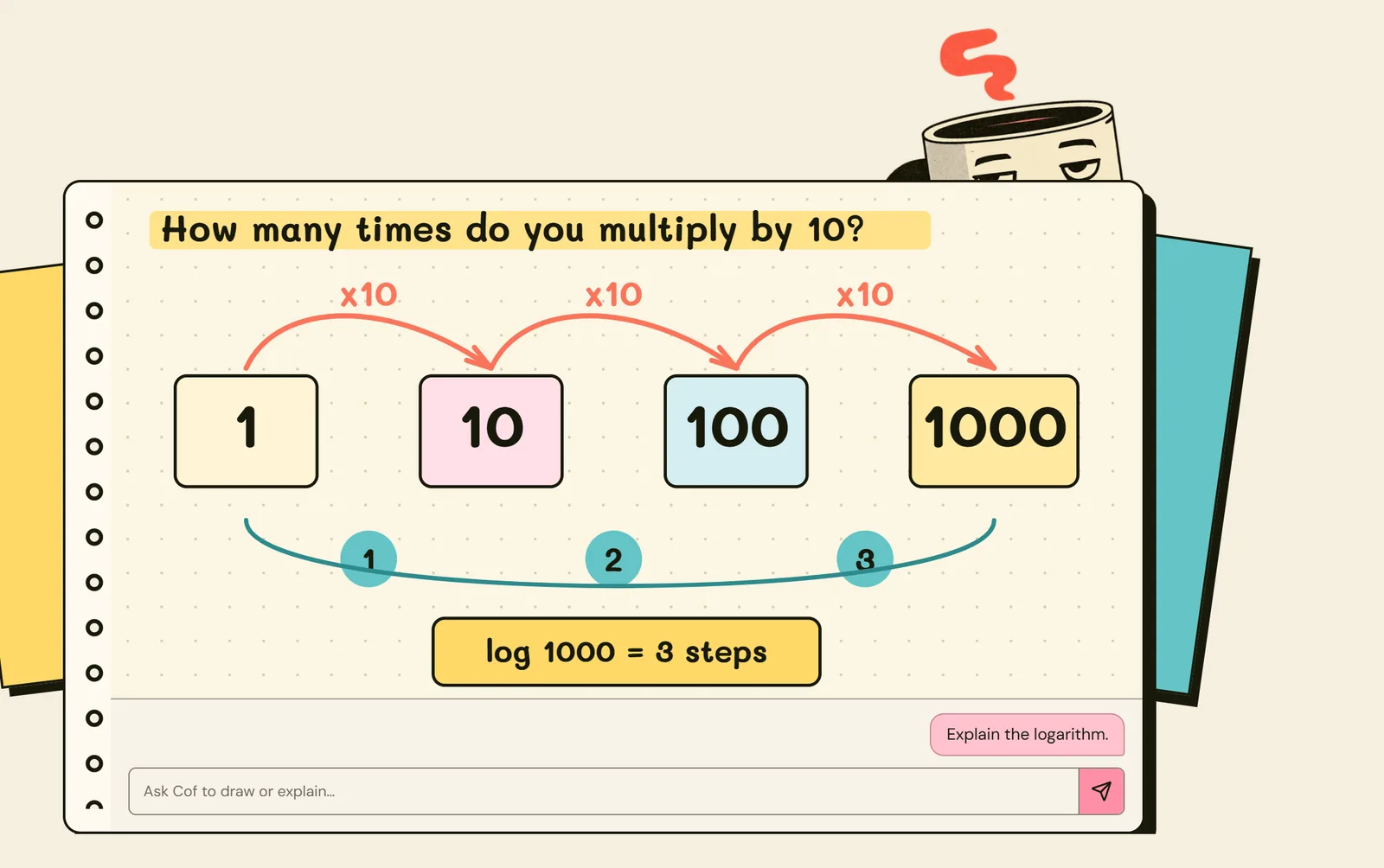
A logarithm counts steps of multiplication. 10 × 10 × 10 = 1000 takes three steps, so log 1000 = 3. More on this subject: Math
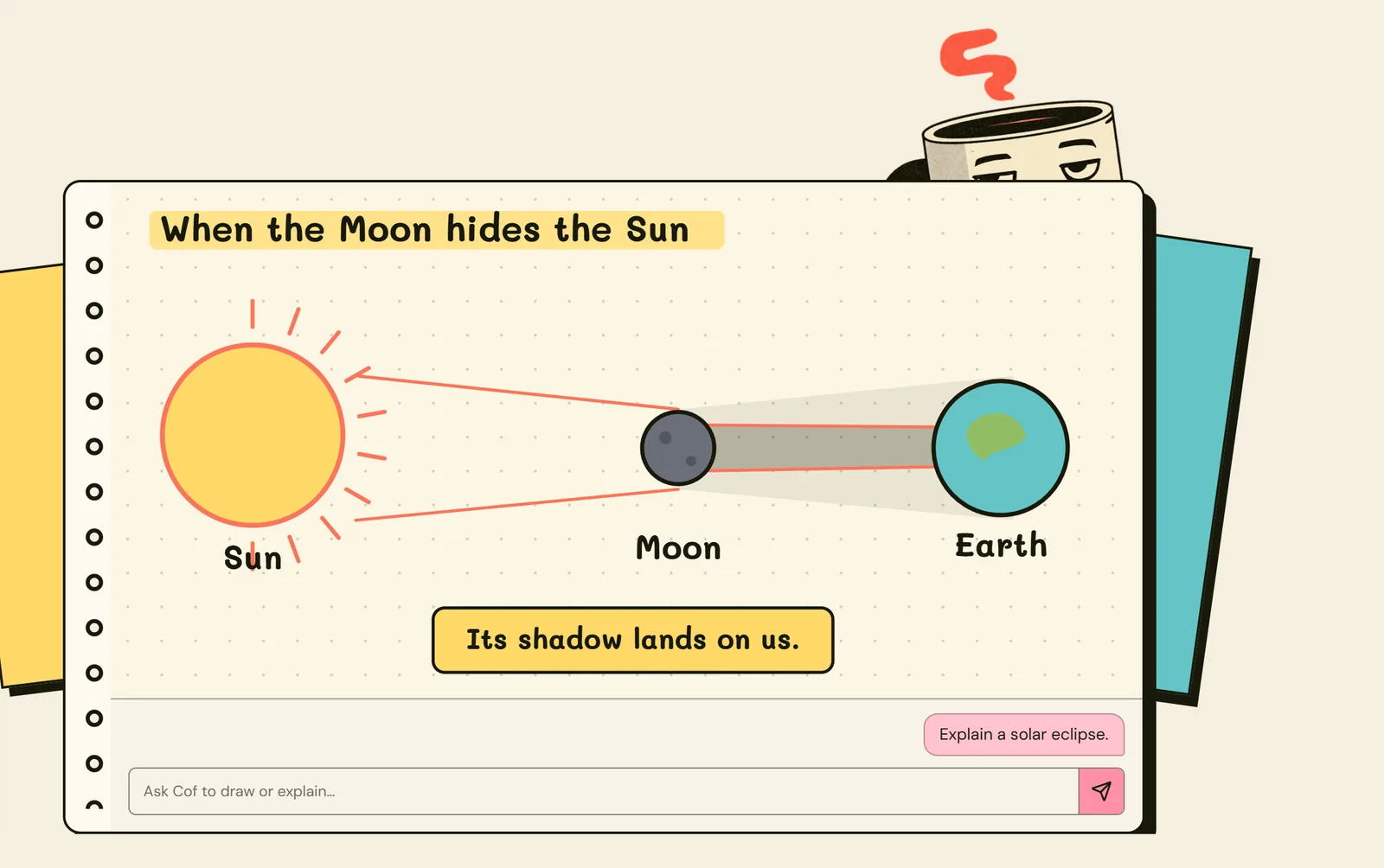
The Moon passes exactly between the Sun and Earth. Where its small shadow touches the ground, the day goes dark for a few minutes. More on this subject: Physics
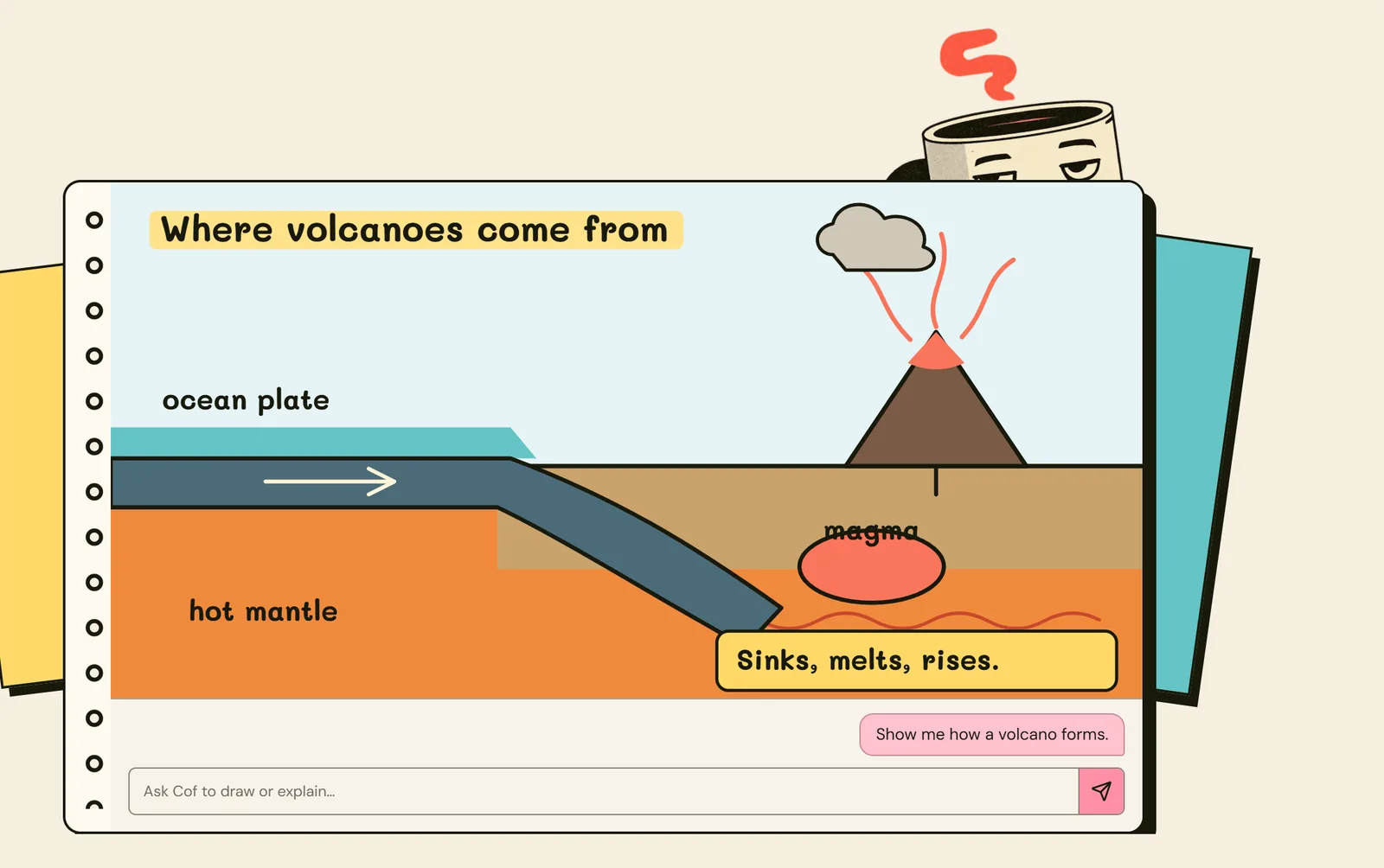
Where an ocean plate slides under another plate, it sinks deep and melts. The hot magma is lighter than the rock around it, so it rises and erupts as a volcano.
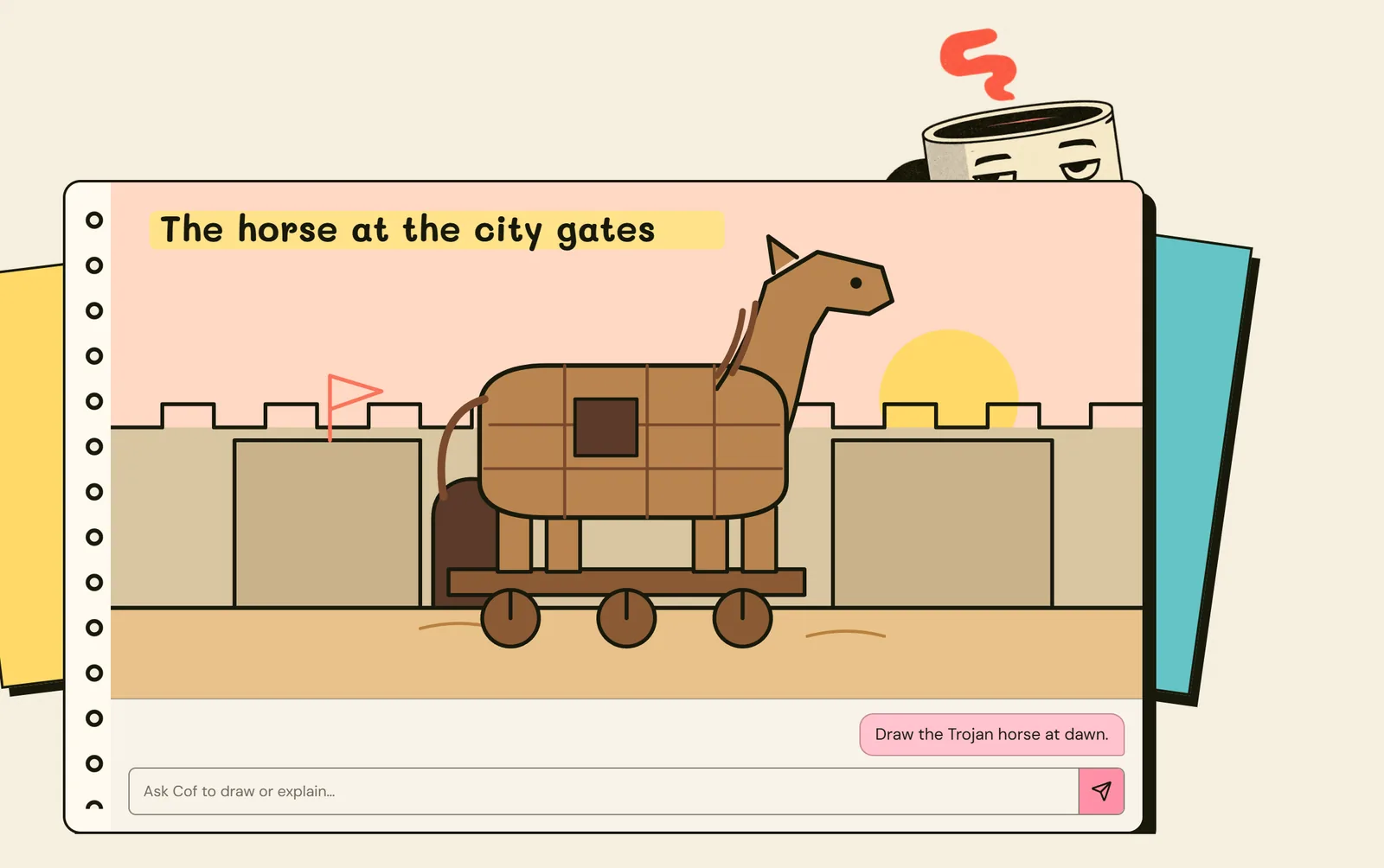
In the Greek legend, soldiers hid inside a giant wooden horse left at the gates of Troy. The Trojans pulled it inside, and at night the soldiers opened the gates. More on this subject: History
Lesson pages
When a topic needs more than one drawing, Cof lays out a whole page on the board: steps, examples, a worked problem or flashcards. Each of these pages is Cof’s answer on the board to a single question.
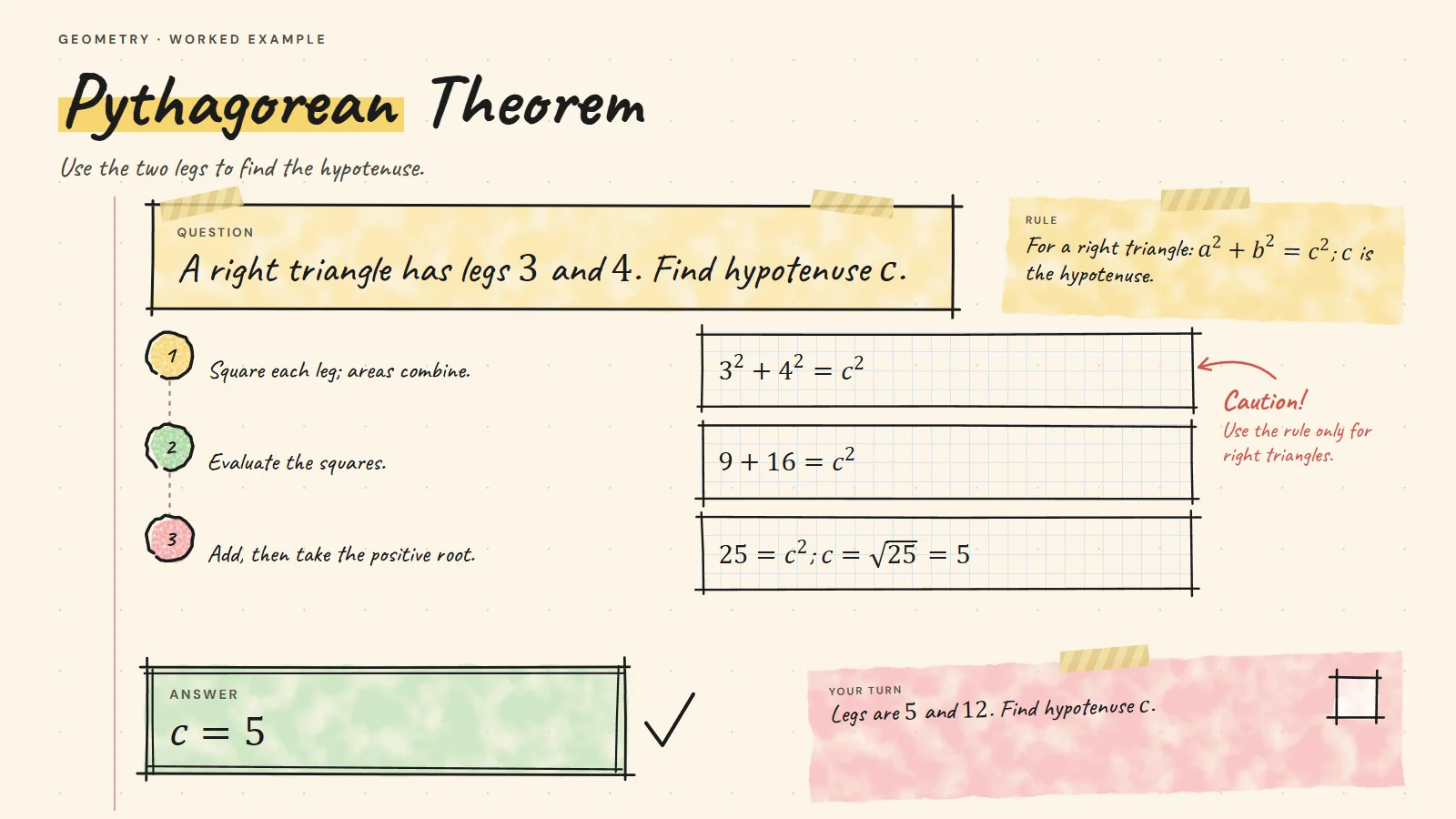
- Problem: a right triangle has legs 3 and 4. Find the hypotenuse c.
- Square each leg; the two square areas add up: 3² + 4² = c².
- Evaluate the squares: 9 + 16 = c².
- Add, then take the positive root: c² = 25, so c = √25 = 5.
- Rule: in a right triangle a² + b² = c², where c is the hypotenuse. Use it only for right triangles.
- Your turn: the legs are 5 and 12. Find c.
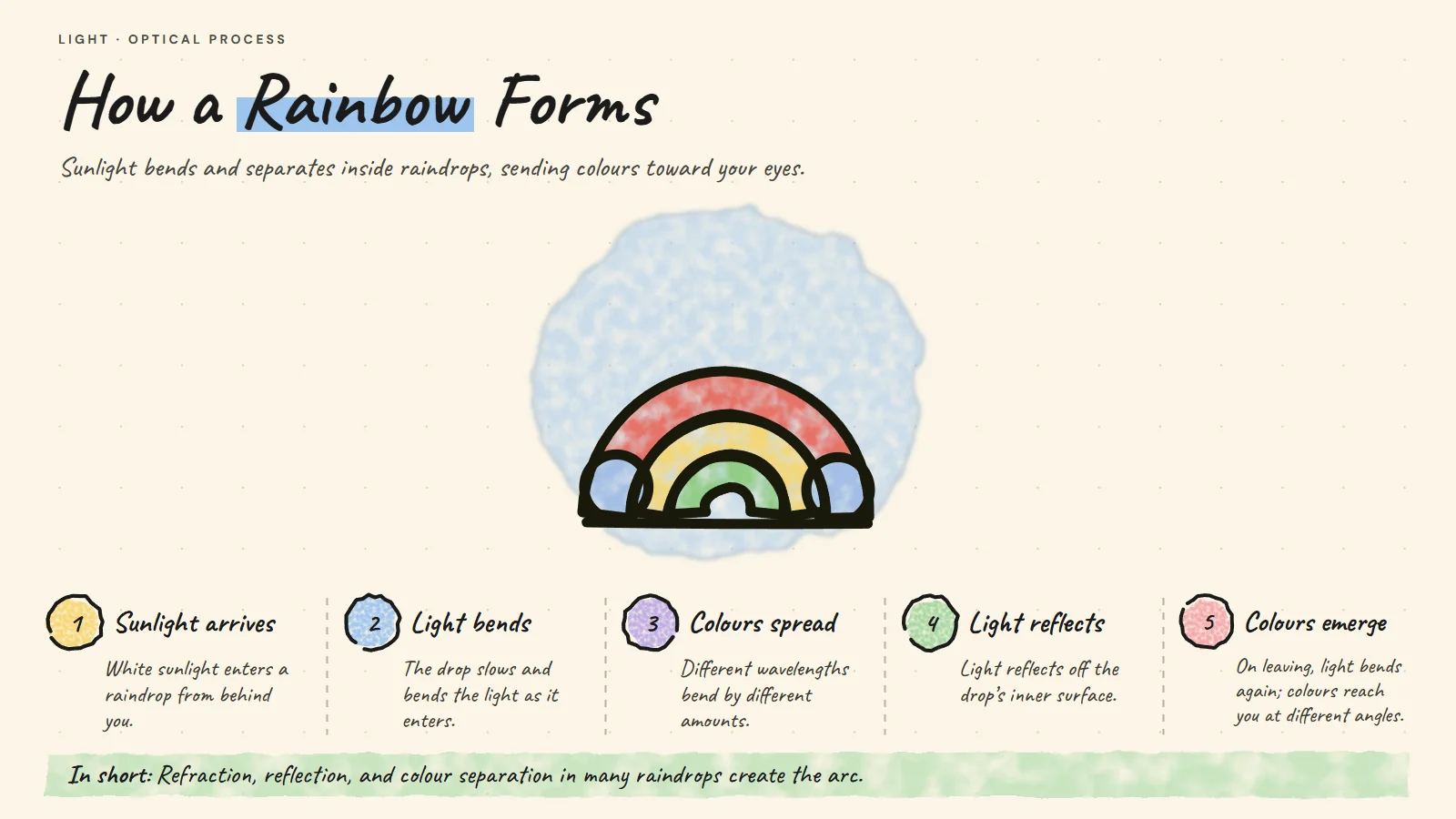
- Sunlight arrives: white sunlight enters a raindrop, with the Sun behind you.
- Light bends: the light slows down and bends as it enters the water (refraction).
- Colours spread: different wavelengths bend by different amounts; violet bends more than red.
- Light reflects: the light reflects off the inside back of the drop.
- Colours emerge: leaving the drop, the light bends again and each colour reaches your eye at a slightly different angle.
- In short: refraction, reflection and colour separation in many raindrops make the arc.
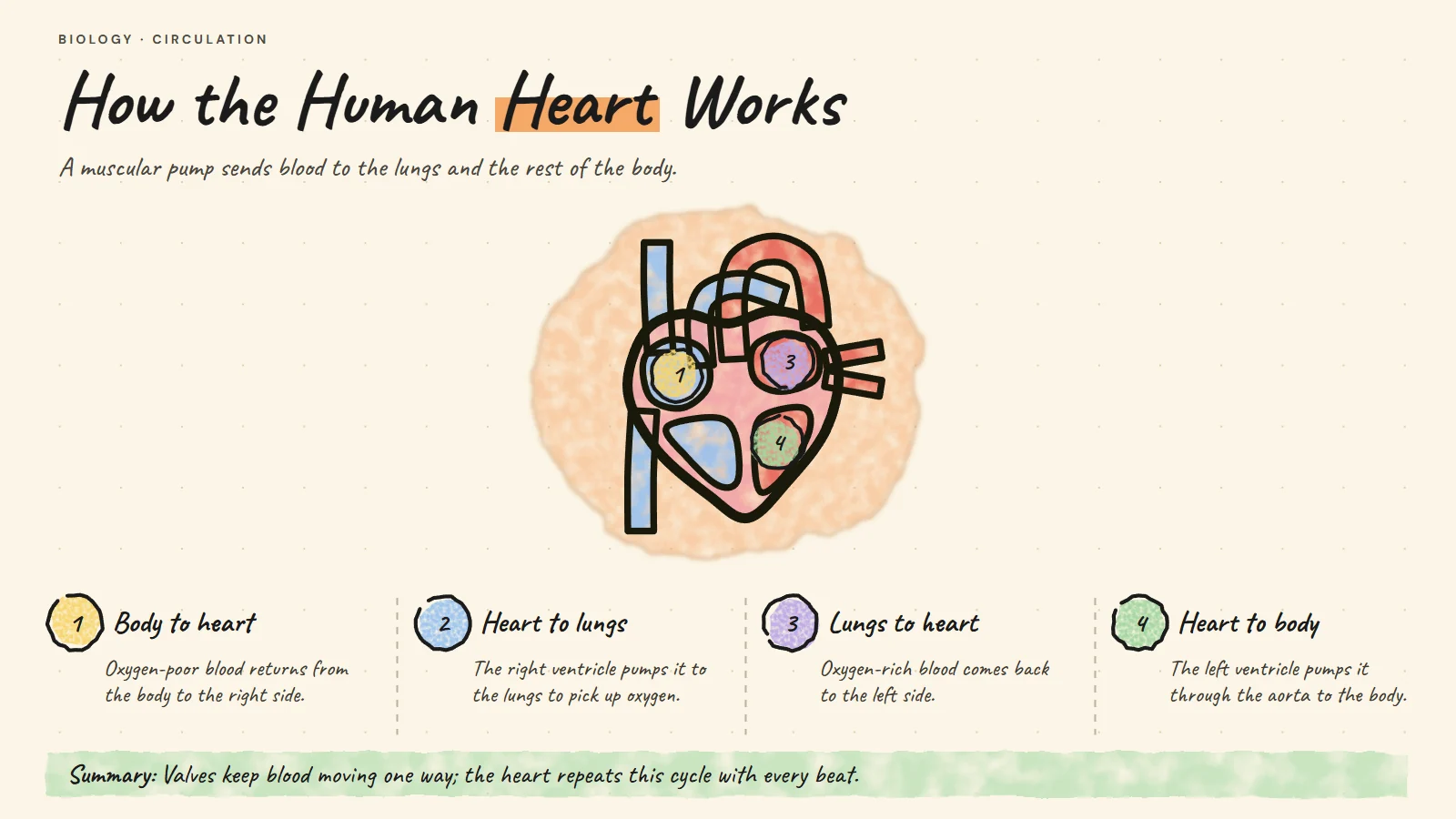
- Body to heart: oxygen-poor blood returns from the body into the right side of the heart.
- Heart to lungs: the right ventricle pumps it to the lungs, where it gives off carbon dioxide and picks up oxygen.
- Lungs to heart: oxygen-rich blood comes back into the left side of the heart.
- Heart to body: the strong left ventricle pumps it through the aorta to the body.
- Valves keep blood moving one way; the heart repeats this cycle with every beat.
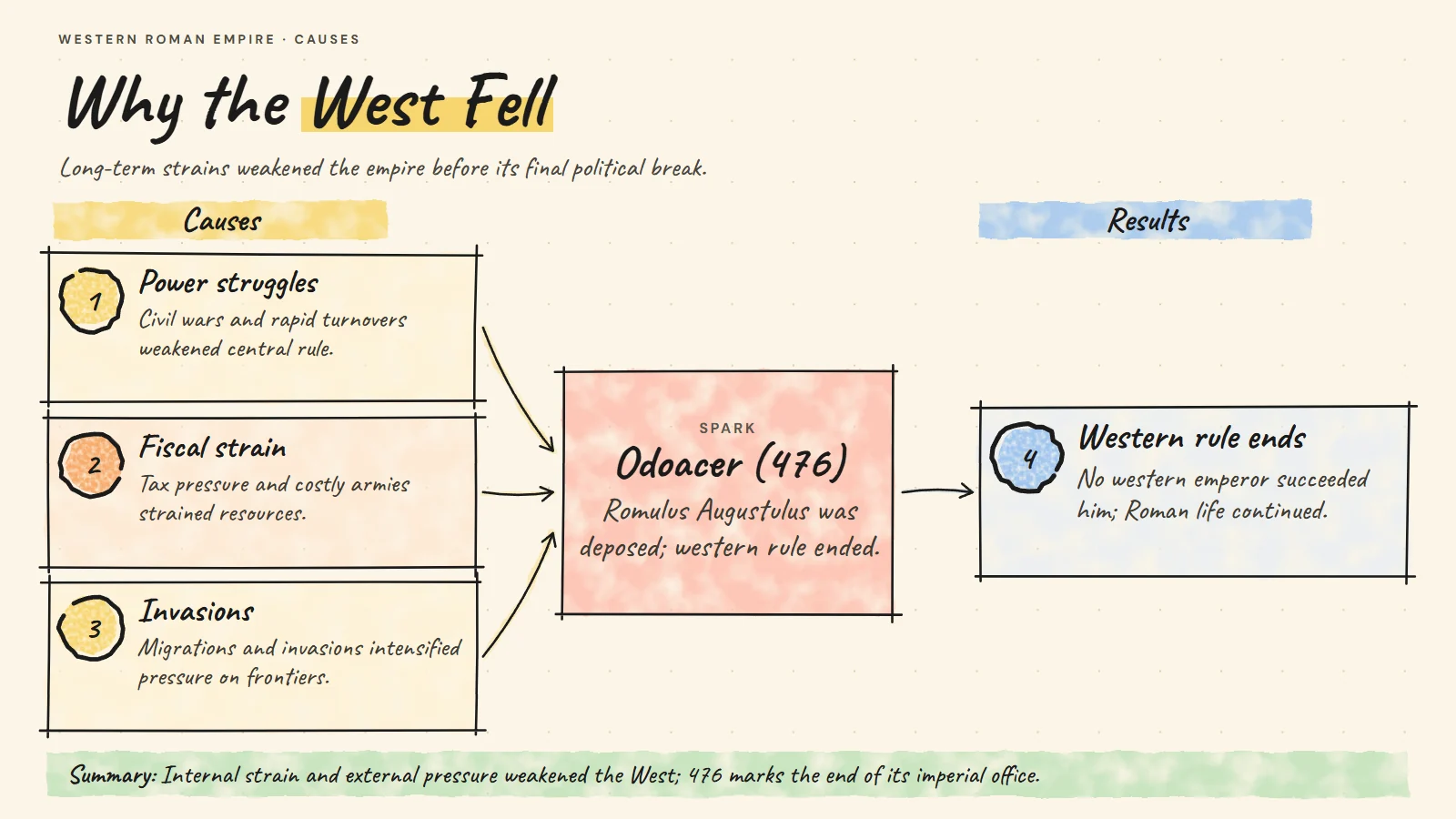
- Cause, power struggles: civil wars and quick changes of emperor weakened central rule.
- Cause, fiscal strain: taxes and costly armies drained resources, and instability made revenue harder to collect.
- Cause, invasions: migrations and invasions put growing pressure on the frontiers.
- Turning point, 476: Odoacer deposed Romulus Augustulus, the last western emperor.
- Result: no western emperor followed him, but Roman laws, institutions and culture did not simply disappear.
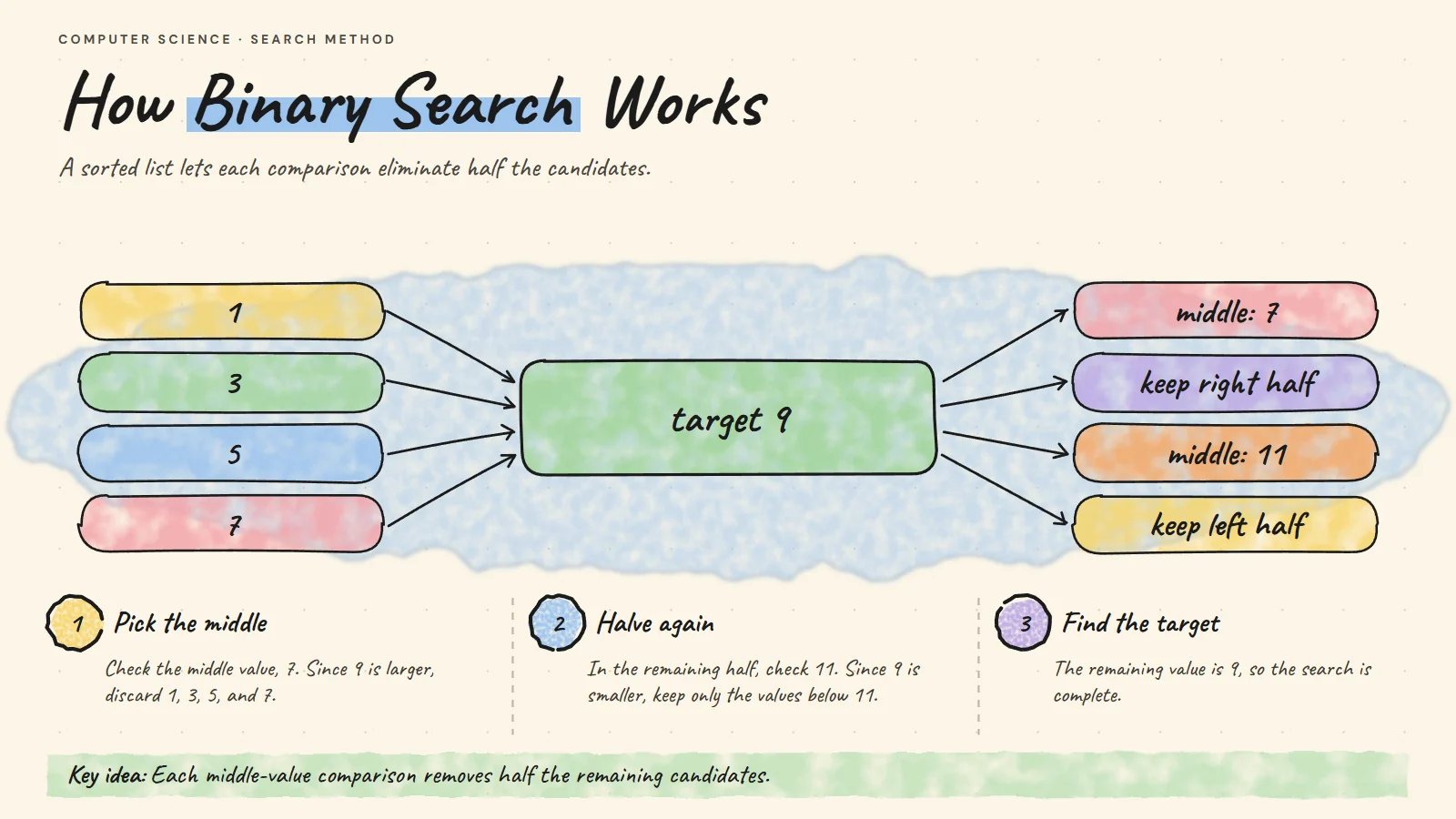
- Sorted list: 1, 3, 5, 7, 9, 11, 13. Target: 9.
- Pick the middle: check 7. Since 9 is larger, discard 1, 3, 5 and 7.
- Halve again: in the remaining half check 11. Since 9 is smaller, keep only the values below 11.
- Find the target: only 9 is left, so the search is complete.
- Key idea: each comparison with the middle value removes half of the remaining candidates.
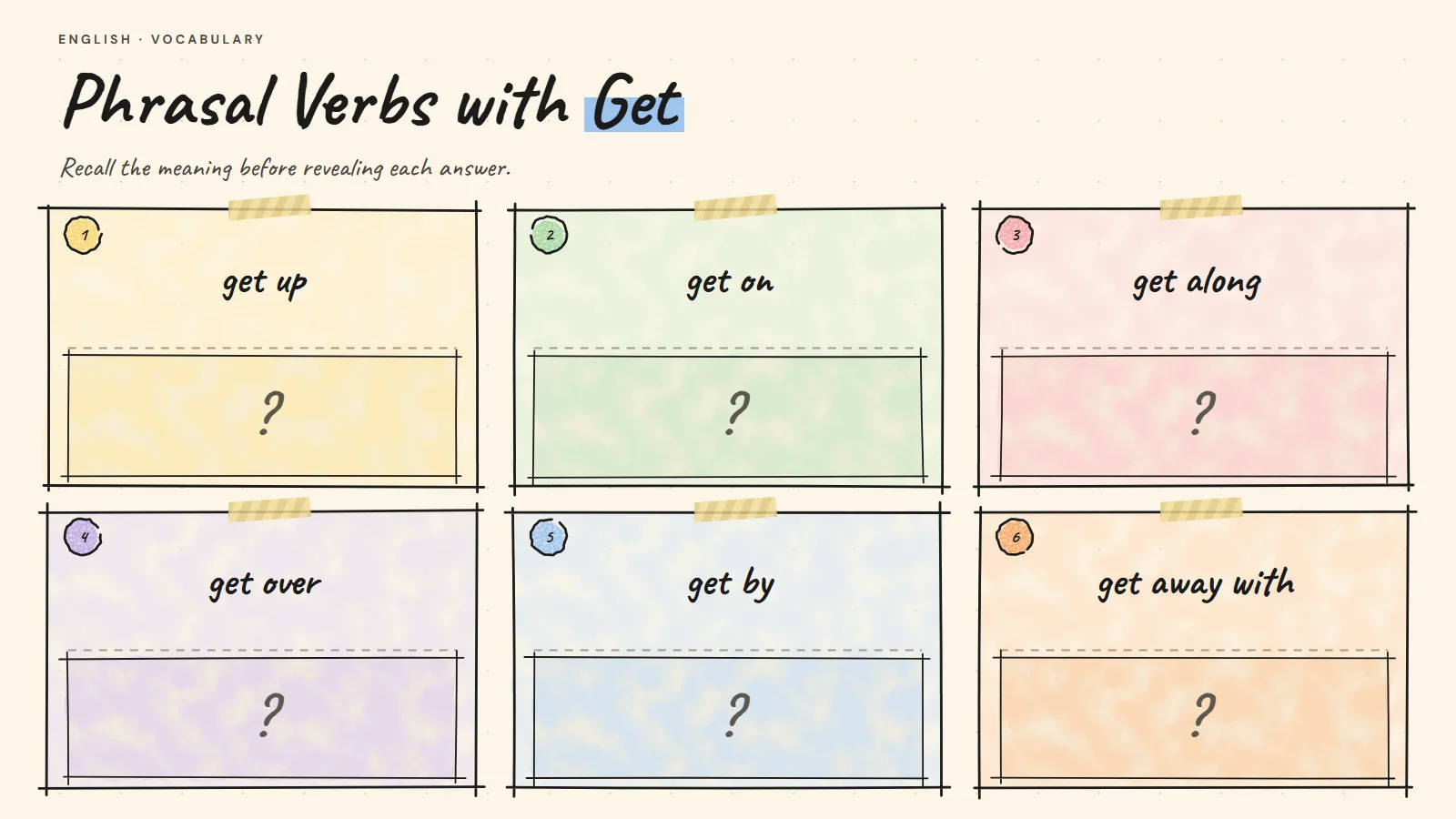
- get up: rise from bed; stand up
- get on: board a bus, train or plane
- get along: have a friendly relationship
- get over: recover from an illness or a setback
- get by: manage with what you have
- get away with: avoid punishment for something wrong
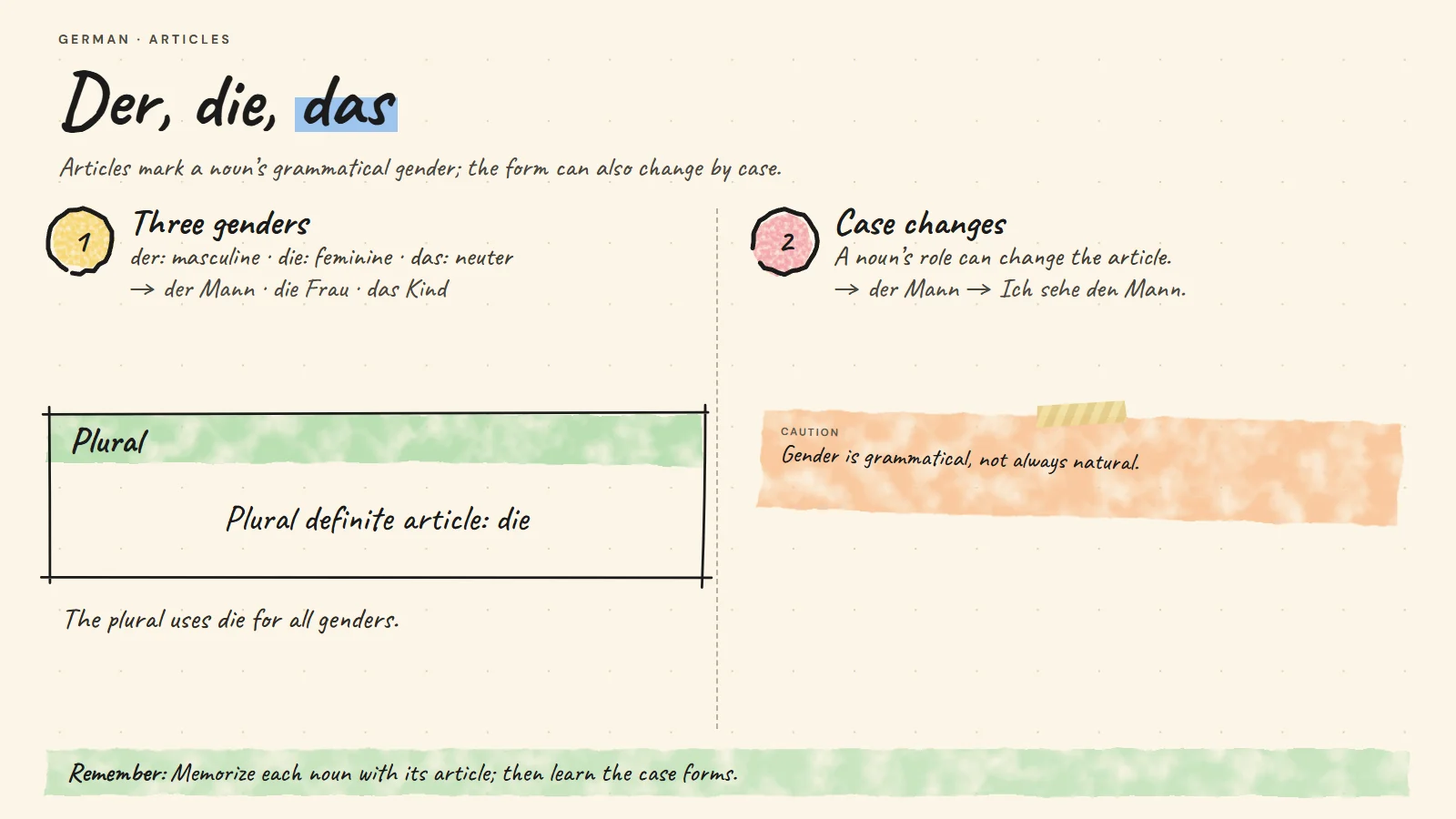
- Three genders: der is masculine, die is feminine, das is neuter: der Mann, die Frau, das Kind.
- Plural: the plural definite article is die for every gender: die Männer, die Frauen, die Kinder.
- Case changes the article: a noun’s role in the sentence changes it, e.g. der Mann → Ich sehe den Mann.
- Watch out: gender is grammatical, not always natural.
- Remember: learn every noun together with its article, then learn the case forms.
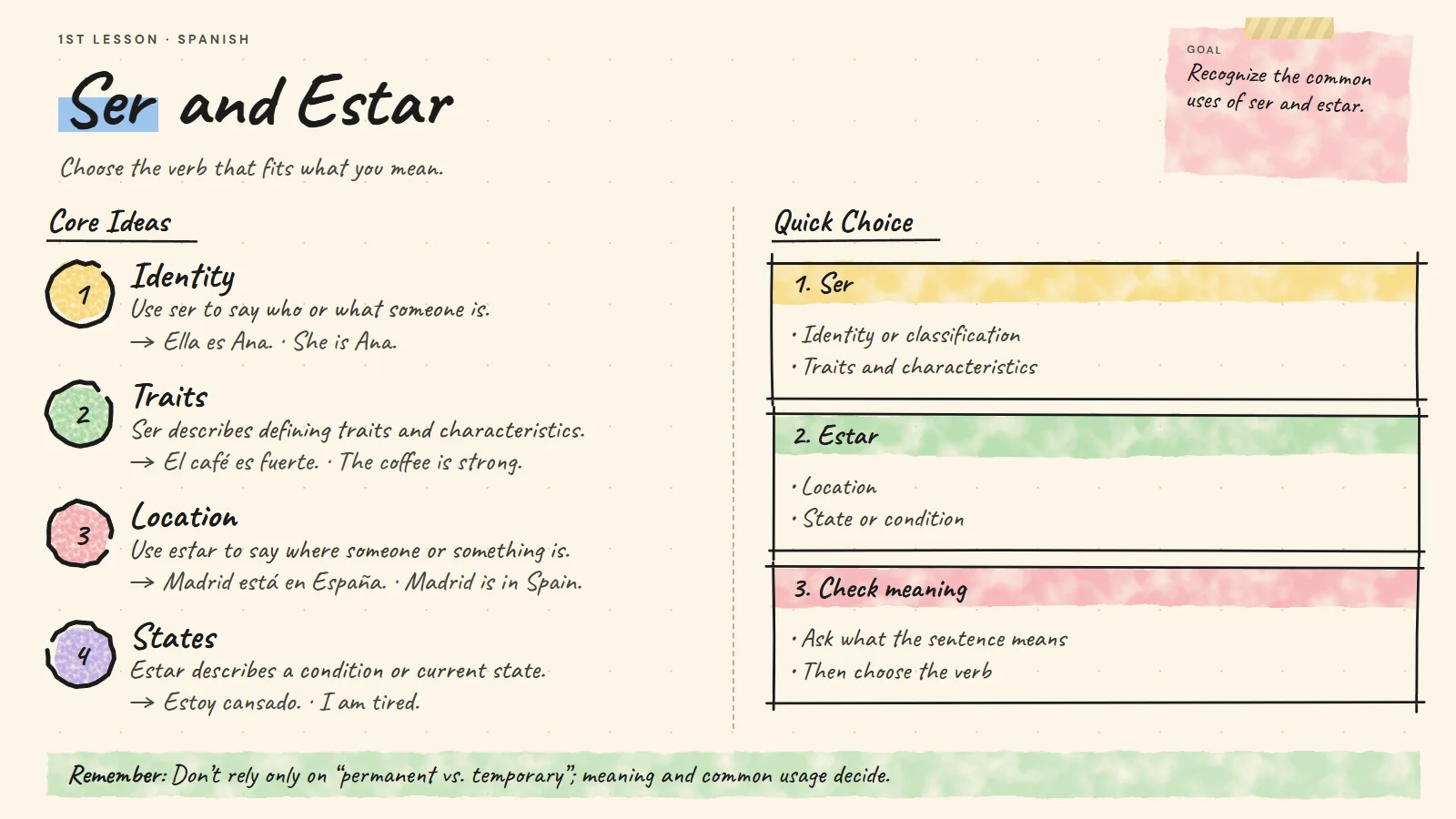
- Identity, ser: say who or what someone is. Ella es Ana. (She is Ana.)
- Traits, ser: describe defining characteristics. El café es fuerte. (The coffee is strong.)
- Location, estar: say where someone or something is. Madrid está en España. (Madrid is in Spain.)
- States, estar: describe a condition right now. Estoy cansado. (I am tired.)
- Quick choice: identity or traits → ser; location or state → estar. Ask what the sentence means, then choose.
- Remember: don’t rely only on “permanent vs. temporary”; meaning and common usage decide.